Go onto any manufacturing floor, and you’ll find an incredible amount of technology hard at work. Enterprise Resource Planning (ERP) manages the business’s financials and raw material ordering. Manufacturing Execution Systems (MES) track the production schedule. Quality Management Systems (QMS) ensure everything meets compliance standards. Meanwhile, thousands of sensors on the shop floor generate a continuous heartbeat of machine data.
On paper, this sounds like a perfectly optimized, modern facility.
But in reality? These systems rarely speak the same language. The ERP thinks a production run is complete; the MES shows it’s stalled on Line 3; the QMS flag shows a batch is on hold; and the shop floor PLC is throwing an undocumented error code.
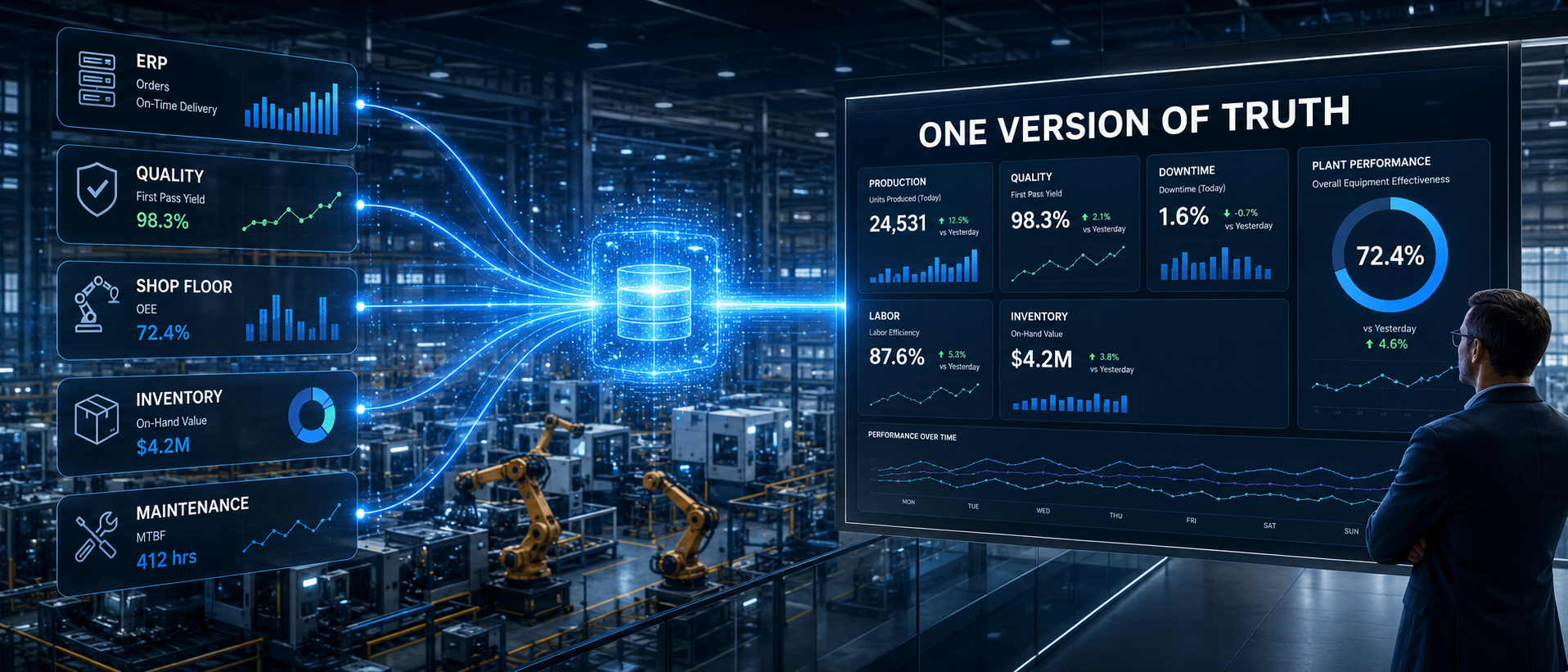
Instead of a smooth digital thread, manufacturers are left with a tangled web of software silos. To scale, reduce waste, and implement advanced technologies like AI, manufacturers must break down these walls and create One Version of Truth. Here is how to do it.
The Root of the Problem: Isolated Islands of Automation
The challenge isn’t a lack of data; it’s a lack of connection. Each software platform was traditionally built to serve a specific department, resulting in distinct functional silos:
-
ERP (The Brain): Operates at a high level. It deals in days, weeks, dollars, and purchase orders. It cares about what needs to be made and when.
-
MES (The Muscle): Operates in shifts, hours, and minutes. It manages execution, tracking exactly how a product moves through the assembly line.
-
QMS (The Guard): Focuses on compliance, deviations, audits, and non-conformances. It cares about quality metrics and safety standards.
-
The Shop Floor (The Heartbeat): Operates in milliseconds. PLCs, SCADA systems, and IoT sensors generate torrents of raw data regarding temperature, vibration, pressure, and speed.
When these systems are isolated, decision-makers are forced to piece together reports manually using spreadsheets. By the time a discrepancy is caught, hours or days of production have already passed, leading to scrap, downtime, and lost revenue.
Architectural Blueprint: The Unified Namespace (UNS)
To move away from point-to-point integrations—which become a nightmare to maintain—modern manufacturers are shifting toward a centralized architecture known as a Unified Namespace (UNS).
Instead of trying to connect the ERP directly to the MES, and the MES directly to every PLC, every system connects to a central data broker. The UNS acts as a centralized repository where all data—from a shop floor sensor to an ERP financial metric—is structured in a clear, hierarchical format that mirrors the physical business (e.g., Site / Area / Line / Machine / Data Point).
[ ERP ]      [ MES ]      [ QMS ]
   │            │            │
───┴────────────┼────────────┴───  <-- Unified Namespace (Central Broker)
                │
         [ Shop Floor IoT ]
When the shop floor registers a machine fault, it publishes that data to the UNS. The MES instantly detects it and adjusts the schedule, while the QMS flags the specific batch for inspection, and the ERP records the potential delay in the supply chain. Everyone and every system reacts to the same data point simultaneously.
Three Steps to Establishing One Version of Truth
Transitioning to a unified data ecosystem doesn’t happen overnight, but following a strategic framework makes it achievable:
1. Standardize and Contextualize Data at the Edge
Raw data from a machine sensor is meaningless on its own. Seeing a value of 98.4 doesn’t help an ERP. Before data leaves the shop floor, it needs context. Edge computing devices should tag that data: Is it $98.4^\circ\text{C}$ or $98.4^\circ\text{F}$? Which machine did it come from? Which product batch was running at that exact millisecond? Contextualization turns raw data into actionable information.
2. Define the System of Record
To prevent data conflicts, you must determine which system owns which metric.
-
Inventory and Costing: The ERP is the ultimate authority.
-
Work-in-Progress (WIP) and Cycle Times: The MES is the source of truth.
-
Defect Codes and Tolerances: The QMS owns this domain.
By clearly defining boundaries, you ensure that systems don’t overwrite each other, keeping the data clean and reliable.
3. Implement Event-Driven Integration
Traditional data integration relies on “batch processing”—sending updates every hour or at the end of a shift. One Version of Truth requires event-driven communication. When a critical event occurs—such as a quality test failing in the QMS—it should instantly trigger data updates across the ERP and MES.
The Business Value of a Single Version of Truth
When ERP, MES, QMS, and shop floor data are synchronized, the operational benefits are immediate:
| Capability | Without a Single Version of Truth | With a Single Version of Truth |
| Traceability | Hours spent digging through paper logs and separate databases during a product recall. | Instant, click-of-a-button genealogy from raw material to shipped product. |
| OEE Tracking | Overly optimistic or inaccurate Overall Equipment Effectiveness (OEE) calculated manually. | Automated, accurate, and real-time OEE dashboards reflecting true floor capacity. |
| Inventory Control | Discrepancies between what the ERP thinks is in stock and what is actually on the floor. | Real-time material consumption tracking, eliminating surprise stockouts. |
| AI Readiness | Predictive models cannot scale due to fragmented, dirty data. | Seamless pipeline to feed clean data into predictive maintenance and machine learning tools. |
Connect Your Ecosystem with Fuzzitech
Achieving One Version of Truth isn’t about replacing your existing software; it’s about unlocking the trapped value within it. By creating an integrated data architecture, you eliminate guesswork, empower your workforce, and build the foundation required for true digital transformation.
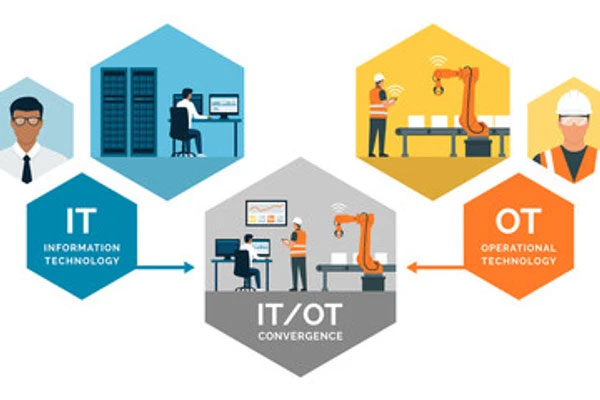
At Fuzzitech, we specialize in bridging the gap between IT and OT, harmonizing systems from the shop floor to the top floor.
Ready to break down your data silos? Contact the Fuzzitech team today to talk with an integration expert and map out your unified data journey.