Manufacturers are under pressure to do more with less.
They need to increase throughput, reduce downtime, improve quality, control labor costs, manage inventory, respond to supply chain disruptions, and deliver to customers on time. At the same time, many are being asked to explore AI and automation as part of their digital transformation journey.
The opportunity is real. AI can help manufacturers make better decisions, identify risks earlier, reduce manual work, and optimize performance.
But AI does not work well when operational data is disconnected, inconsistent, or trapped inside separate systems.
For manufacturers, the real starting point is not simply buying an AI tool. The starting point is building clean, connected operational data and integrating AI into workflows where decisions are already made.
Most manufacturers already have the data they need. It exists across ERP, MES, QMS, maintenance systems, inventory systems, labor systems, shop-floor platforms, spreadsheets, and finance reports. The challenge is that this data often does not work together.
When clean data and AI are integrated into daily operations, manufacturers can begin solving some of their most common and expensive operational problems.
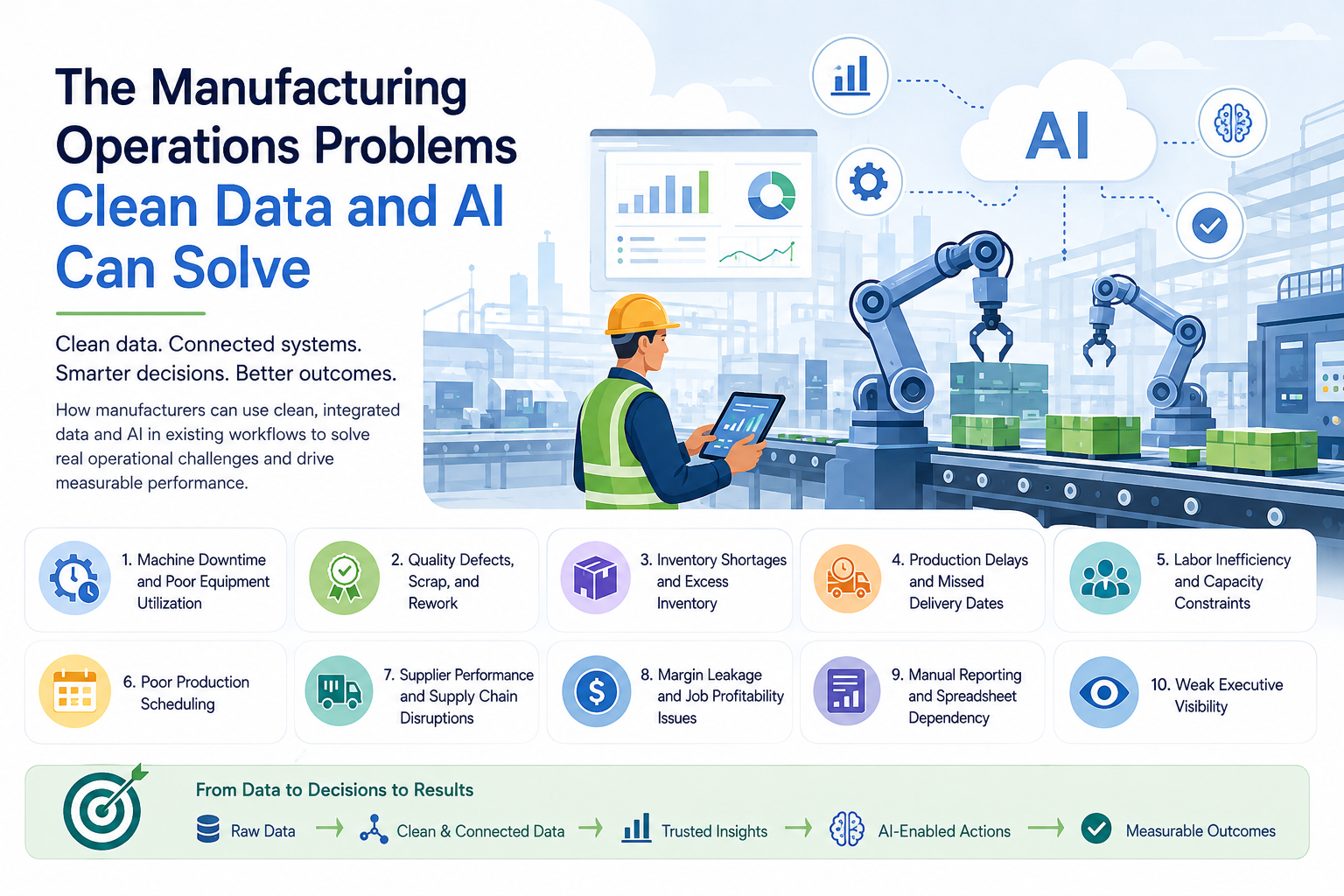
1. Machine Downtime and Poor Equipment Utilization
Downtime remains one of the biggest performance challenges in manufacturing.
A machine may be down because of maintenance issues, missing parts, operator availability, setup delays, quality problems, or poor scheduling. Many manufacturers track downtime, but they often lack the connected data needed to understand recurring patterns and root causes.
Clean data helps connect machine status, downtime codes, maintenance history, work orders, spare parts usage, production schedules, operator notes, and job impact.
AI can then help predict failure risk, identify recurring downtime causes, recommend preventive maintenance actions, and prioritize the machines that create the highest production or financial impact.
The business outcome is clear: less unplanned downtime, better machine utilization, improved throughput, and fewer late orders.
2. Quality Defects, Scrap, and Rework
Quality problems are costly because they consume labor, materials, machine capacity, and management attention. They also affect customer trust.
A defect may be tied to a supplier, material lot, machine, operator, shift, process setting, inspection method, or customer requirement. Without connected data, quality teams may spend too much time investigating symptoms instead of identifying root causes.
Clean data helps connect QMS defects, inspection results, supplier lots, machine data, shift data, work orders, customer complaints, and scrap cost.
AI can help identify defect patterns, suggest likely root causes, flag abnormal quality trends, and recommend where quality teams should investigate first.
The business outcome is fewer defects, reduced scrap, less rework, faster root-cause analysis, and stronger customer confidence.
3. Inventory Shortages and Excess Inventory
Many manufacturers experience two inventory problems at the same time: shortages that delay production and excess inventory that ties up cash.
This happens when inventory, purchasing, supplier lead times, demand, production schedules, and material usage are not connected into one trusted view.
Clean data helps connect ERP inventory, open purchase orders, supplier lead times, production schedules, demand history, material usage, and warehouse data.
AI can help predict stockout risk, recommend reorder priorities, identify slow-moving inventory, optimize safety stock, and flag materials that may delay production.
The business outcome is better material availability, fewer production delays, reduced working capital pressure, and improved cash flow.
4. Production Delays and Missed Delivery Dates
Late orders rarely have one cause. They are often the result of multiple issues: material shortages, labor constraints, machine downtime, quality rework, supplier delays, scheduling conflicts, or inaccurate production status.
When these signals are disconnected, teams often discover the risk too late.
Clean data helps connect customer orders, production schedules, shop-floor progress, inventory availability, purchasing status, labor capacity, and shipping commitments.
AI can help identify orders at risk, predict delivery delays, recommend schedule adjustments, and alert teams before customers are impacted.
The business outcome is better on-time delivery, fewer customer escalations, improved planning, and stronger service performance.
5. Labor Inefficiency and Capacity Constraints
Labor is one of the most important and most constrained resources in manufacturing.
Many manufacturers struggle to understand how labor availability, skills, overtime, shift performance, and training gaps affect production output and quality.
Clean data helps connect labor hours, shift schedules, production output, work centers, job routings, overtime, training records, and quality performance.
AI can help identify productivity gaps, forecast labor needs, recommend staffing adjustments, detect overtime inefficiencies, and connect labor performance to production outcomes.
The business outcome is better labor planning, improved productivity, reduced overtime waste, and more effective use of available talent.
6. Poor Production Scheduling
Production scheduling is difficult when planners lack a complete view of machine availability, labor capacity, material availability, setup times, job priorities, and customer commitments.
A schedule that looks good in the system may fail on the floor if it does not account for real operational constraints.
Clean data helps connect ERP jobs, machine capacity, material availability, labor schedules, customer due dates, setup times, and historical production performance.
AI can help recommend better sequencing, predict bottlenecks, simulate schedule changes, and improve schedule adherence.
The business outcome is smoother production flow, fewer bottlenecks, better use of capacity, and stronger delivery performance.
7. Supplier Performance and Supply Chain Disruptions
Supplier delays, quality issues, changing lead times, and unreliable communication can create major manufacturing problems.
A supplier issue can lead to material shortages, late production orders, expediting costs, customer delays, and margin pressure.
Clean data helps connect supplier performance, purchase orders, lead times, receipts, material shortages, supplier quality issues, production delays, and cost impact.
AI can help predict supplier risk, flag late purchase orders, identify high-risk materials, recommend alternative sourcing actions, and show the impact of suppliers on delivery and margin.
The business outcome is better supply chain visibility, stronger supplier management, fewer material disruptions, and improved production reliability.
8. Margin Leakage and Job Profitability Issues
Many manufacturers do not know which jobs, products, or customers are truly profitable until after the work is complete.
Margin leakage can come from inaccurate quotes, labor overruns, material cost increases, scrap, rework, purchasing variance, machine downtime, freight cost, or customer-specific requirements.
Clean data helps connect quotes, job costs, labor, materials, scrap, rework, purchasing variance, machine time, shipping cost, and invoice data.
AI can help detect margin variance early, identify unprofitable patterns, recommend pricing or process improvements, and highlight jobs at risk before completion.
The business outcome is better profitability visibility, faster corrective action, stronger pricing decisions, and improved financial performance.
9. Manual Reporting and Spreadsheet Dependency
Many manufacturing teams still spend hours exporting data from ERP systems, cleaning spreadsheets, building reports, and emailing updates.
This creates delays, errors, and different versions of the truth.
Clean data helps connect ERP, production, quality, maintenance, inventory, finance, supplier, and customer data into trusted dashboards and workflows.
AI can help automate summaries, explain KPI changes, generate daily operations briefs, answer natural-language questions, and reduce manual analysis time.
The business outcomes are faster reporting, fewer errors, better decision-making, and more time for teams to focus on improvement rather than reconciliation.
10. Weak Executive Visibility
Executives often receive lagging reports but do not always have real-time visibility into operational risk.
They may see monthly financial results but not the operational patterns that created them. They may know that delivery performance changed, but not whether the cause was downtime, labor, inventory, supplier performance, or quality.
Clean data helps consolidate production, quality, downtime, labor, inventory, supplier, finance, and customer delivery data into a single trusted leadership view.
AI can help create executive summaries, identify business risks, connect operations to margin, recommend leadership actions, and highlight which KPIs need attention.
The business outcomes are greater leadership visibility, faster decision-making, improved alignment between operations and finance, and stronger business performance.
The Right Framework: From Raw Data to AI-Enabled Outcomes
For manufacturers, AI should not be treated as a standalone tool. It should be integrated into the way the business already operates.
A practical path looks like this:
Raw operational data → clean and connected data foundation → trusted dashboards → alerts and exceptions → AI-enabled recommendations → measurable business outcomes
This approach helps manufacturers move step by step.
First, connect the data.
Then, build trust in the numbers.
Then, create visibility through dashboards.
Then, add alerts and exception management.
Then, apply AI where it can improve decisions and create measurable value.
The goal is not to replace existing systems. The goal is to unlock more value from the systems manufacturers already have.
Why Workflow Integration Matters
AI creates value only when it is embedded into daily work.
A predictive maintenance model is useful only if maintenance teams use its recommendations to adjust priorities.
A quality insight is useful only if quality teams investigate the pattern and act on it.
An inventory alert is useful only if purchasing and planning teams have a response process.
An executive AI summary is useful only if leadership uses it to make faster decisions.
This is why clean data and AI must be connected to the workflow.
Manufacturers should ask:
Who will use the insight?
What decision will improve?
What action should follow?
How often will the insight be reviewed?
Who owns the response?
How will success be measured?
AI should become part of the business’s operating rhythm, not a disconnected experiment.
Fuzzitech’s Approach
At Fuzzitech, we help manufacturers turn disconnected operational data into trusted insights, automation, and AI-enabled decision support.
Our approach begins with a Data & AI Diagnostic. We assess current systems, data quality, reporting gaps, KPI definitions, integration needs, workflow constraints, and AI readiness. We identify the highest-value use cases and create a practical roadmap focused on business outcomes.
We help manufacturers connect data across production, quality, downtime, labor, inventory, suppliers, finance, and executive KPIs. From there, we help build dashboards, alerts, automation workflows, and AI capabilities that support real decisions.
Our focus is practical: improve performance, reduce manual work, increase visibility, and help leaders scale AI with confidence.
The Leadership Question
Manufacturers do not need AI for the sake of AI.
They need AI that helps solve real operational problems.
The leadership question is not only:
“What AI tool should we buy?”
The better question is:
“Do we have clean, connected data and the right workflows to turn AI into measurable business outcomes?”
When manufacturers build the right data foundation and integrate AI into existing workflows, they can reduce downtime, improve quality, optimize inventory, increase labor productivity, strengthen supplier performance, improve margins, and make better decisions faster.
That is how clean data and AI move from technology discussion to operational advantage.
Fuzzitech helps manufacturers connect operations data, build trusted insights, and integrate AI into the workflows that drive measurable manufacturing performance.