As the founder of Fuzzitech, I spend a lot of time on factory floors, in boardrooms, and staring at data architecture. Over the last few years, I’ve noticed a frustrating trend: manufacturers are absolutely drowning in data yet starving for insights.
We’ve plugged every machine into the network, stuck sensors on every conveyor belt, and invested heavily in the Industrial Internet of Things (IIoT). But if you ask a plant manager what’s happening on Line 3 right now—and how it impacts this quarter’s bottom line—you’re often met with a shrug and a promise to check the weekly report.
In a world moving at the speed of digital, weekly reports are just post-mortems. To compete today, you need to know what’s happening in the present tense.
That is the core of Operational Intelligence (OI).
Moving Beyond Business Intelligence
To understand Operational Intelligence, it helps to contrast it with something you likely already use: Business Intelligence (BI).
While they sound similar, they serve entirely different masters.
| Feature | Business Intelligence (BI) | Operational Intelligence (OI) |
| Time Horizon | Historical (Past days, weeks, months) | Real-time / Right-now |
| Data Focus | Aggregated, static data lakes | Dynamic, continuous data streams |
| Primary User | Executives, analysts, planners | Plant managers, operators, and engineers |
| Objective | Strategic planning and long-term trends | Immediate problem-solving and optimization |
Think of BI like your company’s rearview mirror. It’s excellent for seeing where you’ve been and analyzing past performance. Operational Intelligence, however, is your windshield and GPS combined. It tells you what is happening right in front of you, flags an upcoming hazard, and reroutes you before you hit traffic.
The Core Pillars of Operational Intelligence
Operational Intelligence isn’t just a single piece of software; it’s a tactical approach to data ingestion and visualization. At Fuzzitech, we break OI down into three essential capabilities:
- Continuous, Real-Time Data Ingestion
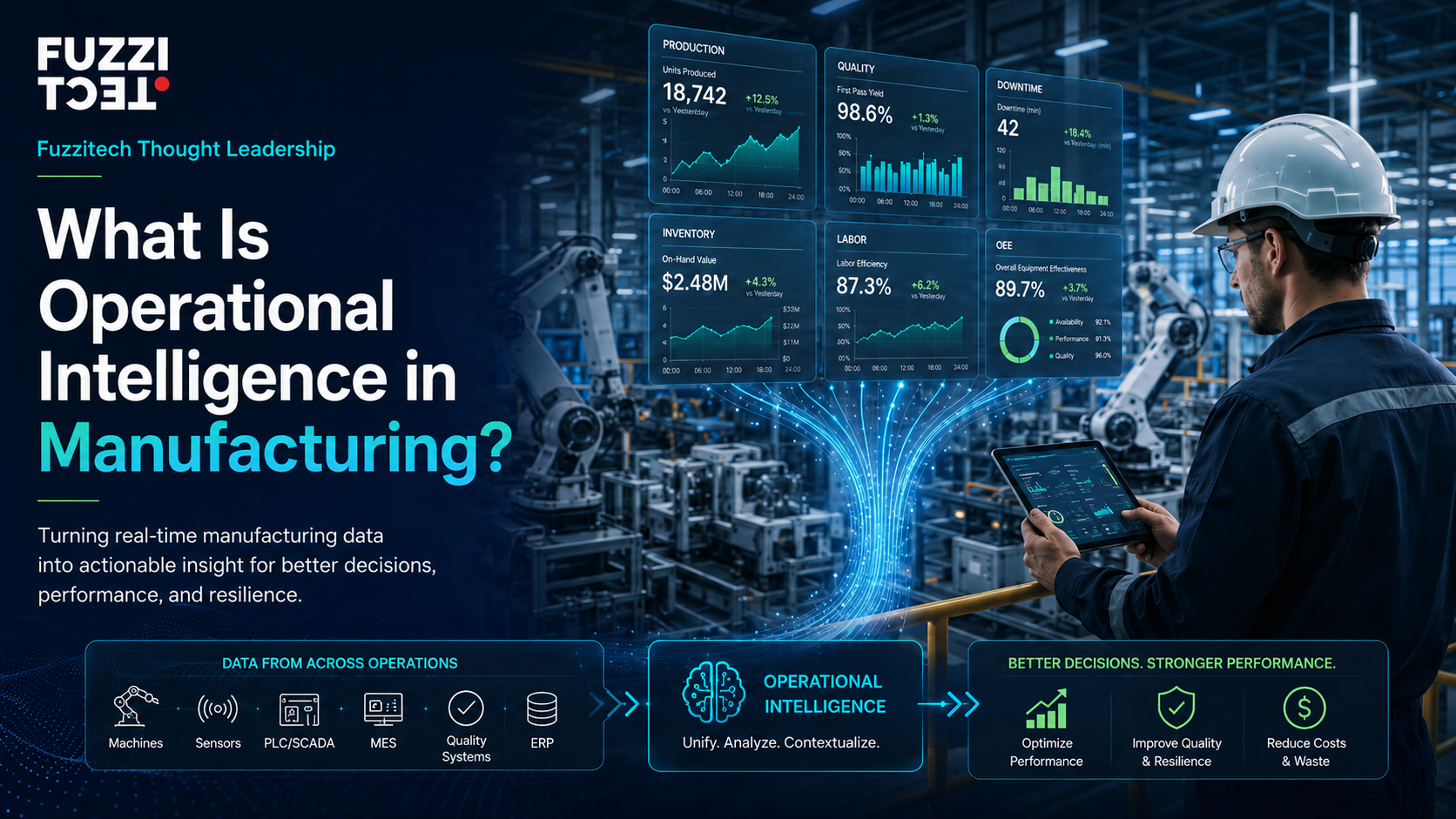
An OI system listens to the pulse of your factory 24/7. It seamlessly blends live telemetry from PLC controllers and IIoT sensors with contextual data from your Manufacturing Execution Systems (MES) and Enterprise Resource Planning (ERP) software.
- Instant Complex Event Processing (CEP)
Data without context is just noise. OI applies real-time analytics to the incoming data streams. If a bearing temperature spikes on a machine, and the throughput drops by 8% simultaneously, the system recognizes this specific pattern instantly—rather than waiting for a manual maintenance log at the end of the shift.
- Live, Actionable Dashboards
OI translates complex machine telemetry into highly visual, intuitive dashboards tailored to the user. A shop floor operator sees a flashing alert indicating an out-of-tolerance part. In contrast, the plant manager sees a live update on how that specific bottleneck is impacting the day’s Overall Equipment Effectiveness (OEE).
Why Manufacturing Needs OI Right Now
We are operating in an era of unprecedented supply chain volatility, fluctuating energy costs, and a tightening skilled labor market. Margins are razor-thin. Waiting until Monday morning to realize you had a high scrap rate on Thursday afternoon is a luxury no modern manufacturer can afford.
When you successfully implement Operational Intelligence, the benefits are immediate and measurable:
- From Reactive to Proactive Maintenance: Instead of waiting for a machine to break down (reactive) or servicing it purely based on the calendar (preventative), OI allows for predictive actions based on actual asset health.
- Empowered Frontline Workers: When operators have real-time visibility into their lines, they don’t have to guess or wait for supervisor approval. They have the data they need to make split-second adjustments that keep production on track.
- Rapid Continuous Improvement (CI): Instead of testing a process change and waiting a month to see the data, CI teams can run a pilot and see the immediate impact on yield, cycle time, and energy consumption in real time.
The Fuzzitech Perspective: Starting Your OI Journey
Implementing Operational Intelligence can feel daunting, especially if your facility is running a mix of legacy hardware and modern machines. But here is the secret: you don’t need to rip and replace your existing infrastructure.
OI is about orchestration. It sits atop your current systems, serving as the connective tissue that brings your data out of its silos and into the light.
At Fuzzitech, our philosophy has always been to start small, think big, and scale fast. Identify a single, persistent bottleneck on your floor. Connect those assets, stream that data, and put a live dashboard in front of the people who can actually fix the problem.
The future of manufacturing belongs to the agile, and agility requires eyes on the present. It’s time to stop looking in the rearview mirror and start running your operations with total clarity.
What’s the biggest data blind spot in your current production line? Let’s talk about how Operational Intelligence can clear it up. Connect with the Fuzzitech team or me to learn more.