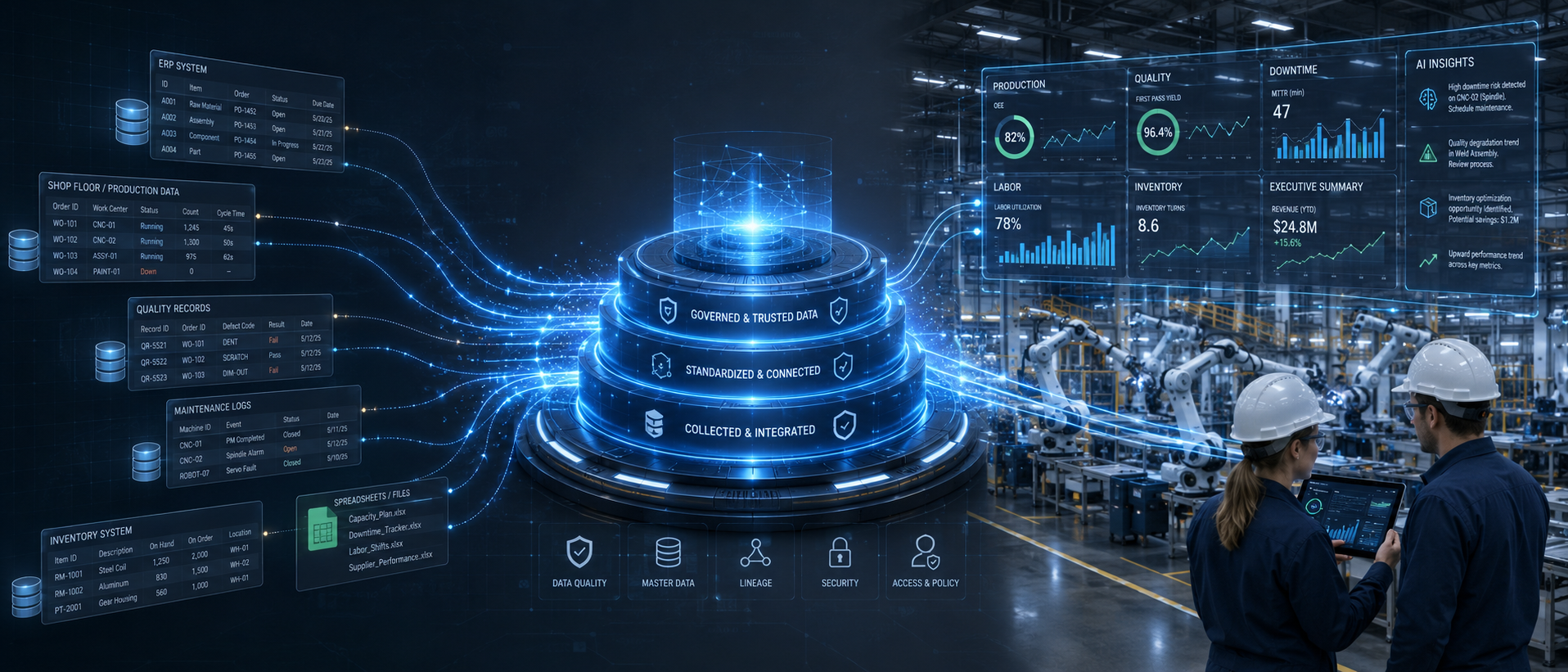
AI is no longer a future concept for manufacturing. It is already entering the plant floor, the front office, the supply chain, and the leadership dashboard.
Manufacturers are exploring AI for predictive maintenance, quality analytics, production scheduling, inventory optimization, supplier risk, customer service, document automation, and executive decision support. The opportunity is real. AI can help manufacturers improve productivity, reduce downtime, increase quality, enhance delivery performance, and make decisions faster.
But there is one important truth that every manufacturing leader needs to understand:
AI cannot scale on disconnected, inconsistent, or untrusted data.
Before manufacturers can scale AI, they need an AI-ready data foundation.
Without that foundation, AI initiatives can become expensive pilots, unreliable dashboards, confusing recommendations, and tools that teams do not trust. With the right foundation, AI can become a practical business capability that improves operations every day.
The Problem: Manufacturers Have Data, But It Is Often Not AI-Ready
Most manufacturers are not short on data.
They already have data in ERP systems, shop-floor systems, quality platforms, maintenance logs, inventory tools, spreadsheets, finance systems, supplier portals, and customer order systems.
The challenge is that this data is often fragmented.
Production data may reside in a single system. Quality data may live in another. Maintenance notes may be stored in spreadsheets. Inventory data may not match what is physically available. ERP data may show orders and costs, but not the real-time operational events happening on the plant floor.
This creates a major challenge for AI.
AI needs clean, connected, contextual, and governed data. If the data foundation is weak, AI will struggle to produce useful and trusted answers.
A manufacturer may want AI to predict downtime, but if maintenance history is incomplete, downtime codes are inconsistent, and machine data is disconnected, the AI model will be unreliable.
A leadership team may want an AI copilot to answer questions about production performance, but if ERP, quality, labor, and shop-floor data are not aligned, the answers may be inconsistent.
A plant manager may want AI to identify root causes of quality issues, but if defect data is not connected to machine, shift, material, supplier, and process data, the insight will be incomplete.
This is why data readiness must come before AI scale.
What an AI-Ready Data Foundation Means
An AI-ready data foundation is not just a database or a reporting platform. It is the trusted operating layer that allows business data to be used for analytics, automation, and AI.
For manufacturers, this foundation should include several key elements.
1. Connected Data Across Core Manufacturing Systems
AI becomes more valuable when it can understand the full operating picture.
That means connecting data from systems such as:
- ERP
- MES or shop-floor systems
- Machine monitoring systems
- Quality management systems
- Maintenance systems
- Inventory and warehouse systems
- Labor and timekeeping systems
- Supplier and purchasing systems
- CRM and customer order systems
- Finance and costing systems
- Spreadsheets and manual operational files
When these systems remain disconnected, AI sees only part of the story. When they are connected, AI can help identify patterns across production, quality, downtime, labor, inventory, cost, and customer delivery.
2. Trusted KPI Definitions
AI cannot create trusted insights if the business does not agree on what the numbers mean.
Manufacturers often struggle with inconsistent KPI definitions.
What counts as downtime?
How is machine utilization calculated?
What is included in labor efficiency?
How is scrap measured?
How is on-time delivery defined?
Which costs are included in job margin?
How are production delays categorized?
If operations, finance, quality, and leadership define metrics differently, AI will only amplify confusion.
An AI-ready data foundation requires common definitions for the KPIs that matter most. This is how manufacturers create one version of the truth.
3. Clean and Consistent Data
AI does not require perfect data, but it does require usable data.
Manufacturers need to address common data quality issues, such as:
- Missing fields
- Duplicate records
- Inconsistent item names
- Incorrect downtime codes
- Incomplete maintenance notes
- Unstructured quality comments
- Manual spreadsheet errors
- Inconsistent customer or supplier names
- Outdated inventory records
- Conflicting production status updates
Poor data quality creates poor AI output. It also creates mistrust. If users do not trust the answers, they will not use the AI solution.
4. Business Context
AI needs more than raw data. It needs context.
For example, a production delay may not be meaningful without knowing the customer priority, job margin, material availability, machine capacity, labor schedule, and delivery commitment.
A quality issue may not be fully understood unless it is connected to the supplier, material lot, machine, shift, operator, inspection result, and product family.
A margin issue may require context from pricing, labor variance, scrap, purchase price changes, rework, and customer-specific requirements.
An AI-ready foundation connects data to its business meaning. This is what allows AI to support better decisions rather than simply summarize records.
5. Security, Governance, and Role-Based Access
AI in manufacturing must be secure and governed.
Manufacturing data can include sensitive customer information, supplier pricing, employee data, proprietary production methods, intellectual property, quality records, and financial performance.
An AI-ready data foundation should include:
- Role-based access control
- Data classification
- Governance policies
- Security monitoring
- Approved AI tools
- Human review for critical decisions
- Clear rules for sensitive data
- Auditability and logging
- Controls for customer, supplier, employee, and financial data
The goal is to help teams use AI safely without exposing sensitive information or creating operational risk.
6. A Scalable Architecture
AI pilots are often built quickly, but scaling AI requires an architecture that can grow.
Manufacturers need a foundation that can support:
- Data pipelines
- Dashboards
- Alerts
- Automation workflows
- AI copilots
- Predictive models
- Reporting and analytics
- Integration with ERP and operational systems
- Future use cases across plants, departments, and business units
A scalable data foundation helps the company avoid having to rebuild from scratch for every new AI initiative.
Why AI Pilots Fail Without the Foundation
Many AI pilots fail not because the AI technology is weak, but because the business foundation is not ready.
Common failure points include:
- The AI cannot access the right data.
- Data quality is too poor to trust the output.
- KPI definitions are inconsistent.
- Users receive different answers from different systems.
- The AI tool is not connected to daily workflows.
- Security concerns slow adoption.
- The use case is not tied to business value.
- The pilot works in a demo but fails in real operations.
This is especially important for mid-size manufacturers. They cannot afford long, expensive AI experiments that do not create measurable results.
They need a practical path that connects AI to real business outcomes.
Real-World Manufacturing Examples
Example 1: Predictive Maintenance
A manufacturer wants to use AI to predict machine failures.
The AI use case sounds straightforward, but it requires a strong data foundation. The system needs access to machine performance data, downtime history, maintenance work orders, parts replacement records, technician notes, production schedules, and asset history.
If that data is incomplete or disconnected, the AI will struggle to identify meaningful patterns.
With an AI-ready data foundation, the manufacturer can identify recurring downtime, prioritize high-risk assets, reduce unplanned failures, and improve maintenance planning.
Example 2: Quality Root Cause Analysis
A manufacturer wants AI to help reduce scrap and rework.
To do this well, AI needs quality inspection results, defect categories, material lots, supplier data, machine data, operator or shift information, process steps, work orders, and customer returns.
If defect codes are inconsistent or quality data is not connected to production data, the AI insight will be limited.
With a trusted data foundation, the company can identify quality patterns faster, reduce recurring defects, and improve corrective action.
Example 3: Inventory Optimization
A manufacturer wants AI to improve inventory planning.
AI needs access to sales orders, purchase orders, supplier lead times, inventory balances, material usage, production schedules, demand patterns, and historical shortages.
If inventory records are inaccurate or supplier lead times are not maintained, AI recommendations may create more risk.
With an AI-ready foundation, manufacturers can reduce stockouts, avoid excess inventory, improve working capital, and protect production schedules.
Example 4: Executive AI Copilot
A leadership team wants an AI assistant that can answer questions about production, margin, quality, delivery, and customer risk.
This requires connected data from ERP, operations, finance, quality, inventory, and customer systems. It also requires common KPI definitions and secure role-based access.
Without that foundation, the copilot may give inconsistent or incomplete answers.
With the right foundation, executives can ask better questions, understand operational performance faster, and focus leadership attention where it matters most.
The Right Sequence: Foundation First, Then AI Scale
Manufacturers do not need to wait years to begin using AI. But they do need to sequence the work correctly.
The practical path usually looks like this:
Step 1: Define the Business Outcomes
Start with the business problems that matter most.
Examples include:
- Reduce downtime
- Improve quality
- Increase throughput
- Improve on-time delivery
- Reduce inventory shortages
- Improve labor productivity
- Reduce manual reporting
- Improve margin visibility
- Improve supplier performance
AI should be tied to measurable business outcomes, not vague innovation goals.
Step 2: Assess Data Readiness
Identify the systems, data sources, quality issues, ownership gaps, and integration needs.
Ask:
- What data do we need?
- Where does it live?
- Who owns it?
- Is it complete?
- Is it accurate?
- Can it be accessed?
- Is it governed?
- Can users trust it?
Step 3: Build the Connected Data Foundation
Create a reliable environment where data can be integrated, cleaned, standardized, and governed.
This may include ERP data, shop-floor data, quality data, maintenance data, labor data, inventory data, and finance data.
Step 4: Create Trusted Dashboards and Alerts
Before scaling AI, manufacturers should create visibility and operational intelligence.
Dashboards and alerts help validate the data foundation and build trust across teams.
Step 5: Add AI-Enabled Insights
Once the data is trusted, AI can help summarize trends, detect anomalies, identify risks, answer questions, and recommend next actions.
Step 6: Scale AI Through Governance and Adoption
AI should be expanded through a disciplined roadmap that includes security, governance, user training, adoption measurement, and ongoing support.
The Competitive Advantage
Manufacturers that build an AI-ready data foundation will be better positioned to compete.
They will be able to:
- Make faster decisions
- Improve operational visibility
- Reduce manual reporting
- Detect risks earlier
- Improve productivity
- Strengthen quality performance
- Reduce downtime
- Optimize inventory
- Improve customer delivery
- Scale AI with confidence
The competitive advantage does not come from AI alone.
It comes from combining AI with trusted data, clear business context, strong governance, and adoption across the organization.
Fuzzitech’s Approach
At Fuzzitech, we help manufacturers build the data foundation needed for analytics, automation, and AI.
Our approach typically starts with a Data & AI Diagnostic. We assess current systems, data quality, reporting gaps, KPI definitions, integration needs, governance risks, and AI readiness. We identify the highest-value use cases and create a practical roadmap.
From there, we help manufacturers connect data across ERP, production, quality, downtime, labor, inventory, finance, and executive KPIs. We help build trusted dashboards, automation workflows, alerts, and AI-enabled insights that support real business outcomes.
Our focus is practical: help manufacturers move from fragmented data to AI-ready operations.
The Leadership Question
Manufacturing leaders should not ask only, “Which AI tool should we buy?”
They should ask:
“Is our data ready to support AI at scale?”
Can our systems connect?
Can our teams trust the numbers?
Are our KPIs clearly defined?
Is our data secure and governed?
Can AI access the context needed to produce useful insights?
Can we measure the business impact?
If the answer is no, the company does not need to abandon AI. It needs to build the foundation that allows AI to succeed.
AI is powerful, but it is only as valuable as the data, process, and business context behind it.
Fuzzitech helps manufacturers build AI-ready data foundations that turn operations data into trusted insights, automation, and scalable AI capabilities.