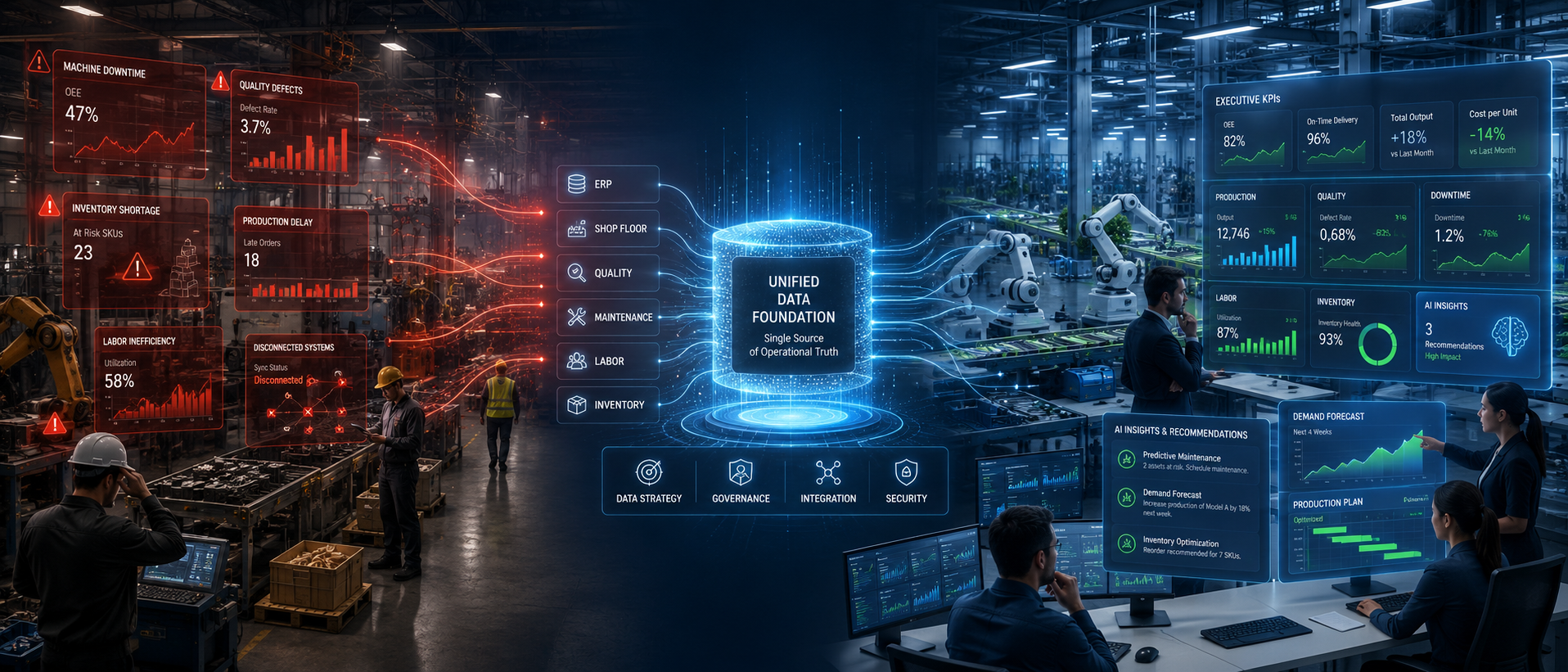
Walk onto almost any manufacturing floor today, and you will hear a familiar story. Machine 3 is down unexpectedly, delaying a critical order. The warehouse thinks they are out of a key component, but the system insists there are 500 units in stock. Meanwhile, the operations team is drowning in a sea of spreadsheets, trying to piece together what went wrong during yesterday’s shift.
Modern manufacturing operations are more complex than ever. We are drowning in data, yet starving for actionable insights.
As manufacturers, we’ve spent years investing in automation, IoT sensors, and ERP upgrades. But having technology isn’t the same as having control. If your shop floor still relies on firefighting and gut feelings, you don’t have a data shortage—you have a strategy shortage.
Here is how today’s operational bottlenecks are crippling factories, and how a combined strategy of unified data and Artificial Intelligence (AI) can turn your shop floor into a self-healing powerhouse.
The Big Three: Today’s Modern Manufacturing Headaches
Before we can fix the problem, we have to call it what it is. Today’s plant managers face three major operational hurdles:
- The Squeaky Wheel Maintenance Trap: Relying on reactive maintenance (fixing it when it breaks) or calendar-based maintenance (fixing it because it’s the first of the month). Both waste millions in unplanned downtime or unnecessary part replacements.
- The Ghost Inventory Dilemma: Supply chains are volatile. When inventory data is delayed by even a few hours, it triggers a chain reaction of over-purchasing, stockouts, and missed delivery deadlines.
- The Siloed Knowledge Gap: Valuable operational knowledge resides in the heads of your veteran operators, not in your systems. When they retire or switch shifts, your efficiency drops.
Phase 1: The Strategy Shift (Data -> Insights)
Many leaders think the solution is to throw AI at the problem immediately. That is a recipe for an expensive failure. AI cannot fix broken data.
Before we introduce intelligence, we must establish a foundation of a clean, contextualized data strategy.
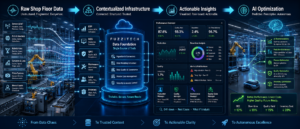
[Raw Shop Floor Data] ➔ [Contextualized Infrastructure] ➔ [Actionable Insights] ➔ [AI Optimization]
- Break Down the Operational Silos
Your machines talk in PLC code, your warehouse talks in barcodes, and your finance team talks in ERP entries. To get true insights, you must unify these data streams into a single, real-time operational layer.
- Move From “What Happened” to “Why It Happened.”
Static end-of-month reports are an autopsy of your losses. A proper data strategy implements real-time dashboards that correlate variables. For example, it shouldn’t just tell you that a batch failed; it should show you why: ambient humidity spiked while Machine 3 was running at a specific RPM.
Phase 2: The AI Revolution (Insights -> Actions)
Once your data strategy provides a clear, real-time picture of your plant, AI moves you from a state of reaction to a state of prediction and prescription.
Predictive Maintenance (PdM)
Instead of waiting for a bearing to shatter, AI algorithms analyze subtle vibrations, temperature fluctuations, and power consumption anomalies from your IoT sensors. The system calculates the exact remaining useful life (RUL) of a component:
RUL = f(T, V, I)
Where:
- T = Temperature signatures
- V = Vibration frequency deviations
- I = Current/Power draw anomalies
The AI then automatically schedules a maintenance window before the failure occurs and orders the required part from the warehouse without human intervention.
Dynamic Production Optimization
Human planners can only calculate so many variables at once. If an unexpected rush order comes in, an AI-driven scheduling engine can instantly recalculate thousands of permutations regarding machine availability, energy costs, labor constraints, and material locations to output the most profitable, efficient production sequence in seconds.
Prescriptive Quality Control
Computer vision paired with machine learning can inspect parts at line speed, identifying microscopic defects far faster than a human inspector. More importantly, the AI can trace the defect back to its root cause upstream and automatically adjust machine tolerances in real-time to prevent further waste.
The Fuzzitech Approach: Think Big, Start Small
The transition to an AI-driven smart factory can feel overwhelming, but it doesn’t happen overnight. At Fuzzitech, we advise our partners to adopt a pragmatic framework:
- Target the Bottleneck: Identify the single machine or process causing your biggest headache.
- Clean the Pipeline: Build a data strategy to capture and contextualize metrics for that specific area.
- Deploy Targeted AI: Implement focused machine learning models to solve that specific problem (e.g., predicting a failure or optimizing a cycle time).
- Scale the Success: Take those learnings and expand them across the rest of your lines.
The future of manufacturing belongs to companies that treat their operational data as a core strategic asset, not just a byproduct of doing business. When you marry a robust data strategy with the predictive power of AI, you stop fighting fires and start scaling profitability.
Is your shop floor ready to leap from reactive to predictive? Let’s build your data road map together. Contact the Fuzzitech team today.