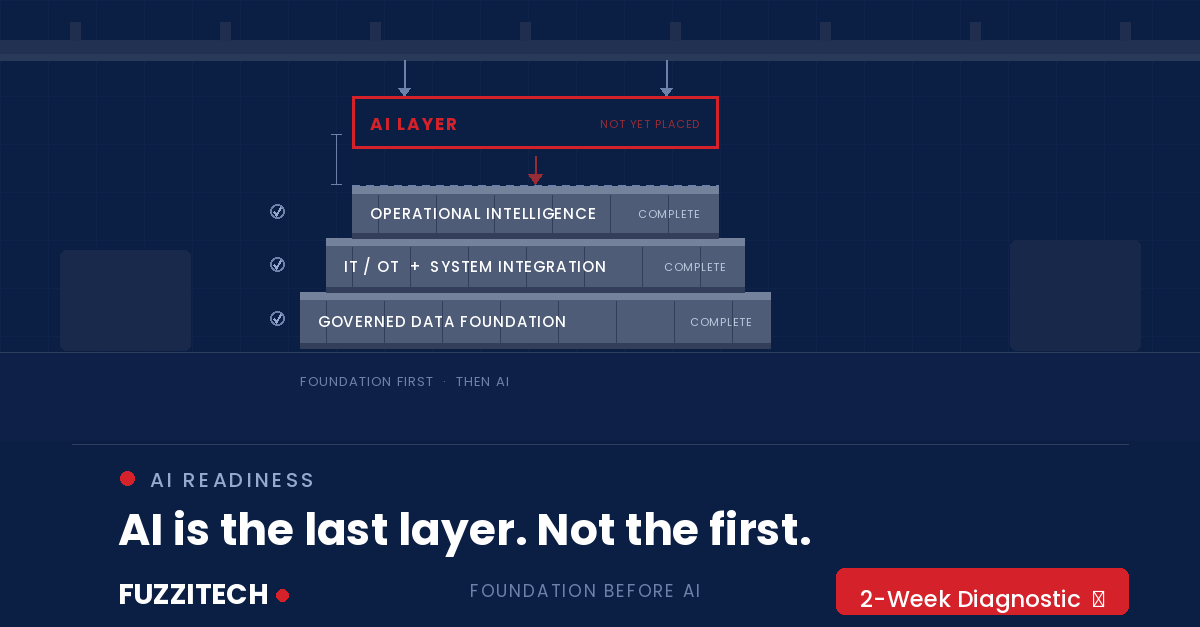
Your board is asking what you’re doing about AI. A vendor has a demo that looks fantastic. And somewhere in the back of your mind is the honest worry that the data underlying your operation isn’t in any shape to support what you’re about to sign. That instinct is correct, and it’s worth trusting before you spend the money.
The “before” state is a pressure state, and it’s less about technology than about position. The CEO is being asked about the AI strategy. The CIO knows the true condition of the data. The CFO wants a defensible business case, and hasn’t been shown one. Meanwhile the market is loud, the demos are polished, and there is real fear of being the manufacturer who moved too slowly.
So a pilot gets bought. And here’s what actually breaks: the pilot succeeds technically and fails operationally. The model works in the demo environment on clean sample data, and then it hits your reality — inventory counts that are days stale, maintenance history in a technician’s notebook, three systems that define “on-time” differently, sensor data that was never stored. The pilot stalls. It doesn’t fail loudly; it just quietly never scales. Twelve months and a lot of budget later, the honest internal summary is “it didn’t really work for us,” and the organization becomes cynical about AI in general — which is the most expensive outcome of all, because the next attempt now has to fight that history.
We’ve watched this pattern enough times to say it plainly: most failed AI projects in mid-market manufacturing are not model failures. They’re foundation failures that were discovered late and at great expense. The technology was never the constraint. The data underneath it was.
The uncomfortable truth is that nobody wants to hear “you’re not ready” — it sounds like a delay. It isn’t. It’s the difference between spending money on a pilot that stalls and spending it on the layer that makes every subsequent use case work.
That’s exactly what AI Readiness is for, and it’s what the 2-Week Diagnostic delivers. In 14 days, we assess the operation as a model would: what data you actually capture, where it lives, how clean and connected it is, and which of your candidate use cases your current foundation can genuinely support. We map the gaps — the missing sensor histories, the ungoverned definitions, the manual bridges — and we translate them into a prioritized roadmap. Not “become AI-ready” as an abstraction, but a sequenced answer to which use cases are viable now, which need a specific foundation investment first, and what that investment actually is.
The output is deliberately concrete: a full data-gap map plus an AI roadmap, prioritized by feasibility and business value. It’s the document that lets a CEO answer the board honestly, lets a CIO show what’s real, and gives a CFO a business case grounded in sequence rather than hope. And crucially, it tells you what not to buy yet.
The measurable “after” starts with the diagnostic itself: in 14 days, you go from “the board is asking, and I’m not sure” to a prioritized roadmap you can defend. From there, the anchors follow the foundation work — teams that close their data gaps typically spend around 60% less time reconciling conflicting reports, one trusted dashboard replaces the five-plus versions in circulation, and operations that get their condition and maintenance data in order before deploying predictive maintenance typically see around a 40% reduction in unplanned downtime. Those are the returns of doing it in the right order. (Any projected AI-specific ROI beyond these anchors is illustrative until we assess your environment.)
Note what those numbers have in common: none of them come from the AI. They come from the foundation. That’s the argument in one line — the foundation pays for itself before the AI ever ships, and then the AI works when it does.
Being AI-ready is not about ambition or appetite. It’s about whether the data underlying your operation can support what you want to build. Find that out in two weeks, for a fraction of what a stalled pilot costs, and then move fast with confidence.
Most failed AI pilots aren’t model failures — they’re foundation failures discovered twelve months and a budget too late.
Start with the 2-Week Diagnostic. In 14 days, you’ll have a full data-gap map and a prioritized AI roadmap — including which use cases your foundation can support today, and which ones shouldn’t be bought yet.
Learn more about how this can be applied to your manufacturing: AI Readiness for Manufacturers | Manufacturing AI Consulting | Fuzzitech
See the manufacturing use cases → https://fuzzitech.com/use-cases/manufacturing-use-cases