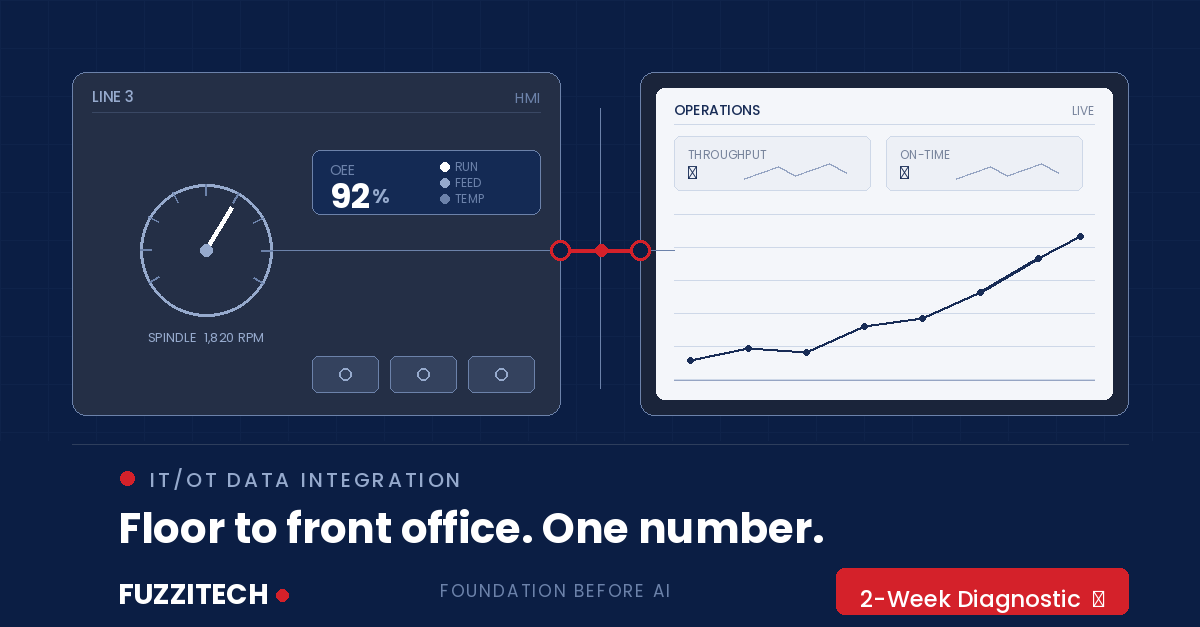
Your PLCs and historians know exactly what ran last shift. Your ERP knows what you promised the customer. The problem is that those two systems have never actually spoken to each other — so someone on your team spends every morning stitching them together by hand, and by the time the numbers agree, they’re already old.
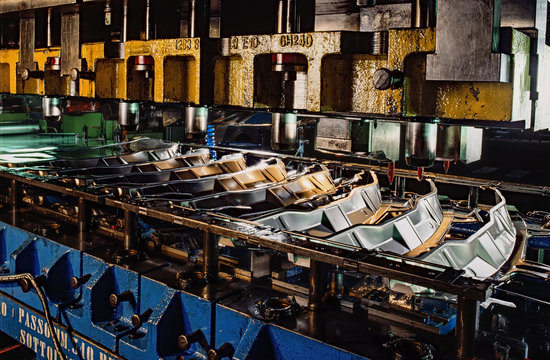
The “before” state on most mid-market floors looks the same whether you’re in Rockford, Green Bay, or Toledo. The operational technology — PLCs, SCADA, historians, the machine controllers themselves — generates a firehose of data about what’s physically happening. The IT side — ERP, MES, the planning and finance systems — runs the business. Between them sits a gap that a person with a spreadsheet bridges.
That works until it doesn’t. What actually breaks isn’t the technology; it’s the trust. A production supervisor reports run rates off the historian. The planner works off ERP. Finance closes the month off a third extract. When those three don’t match — and they never quite do — the argument stops being about what to do and becomes about whose number is real. You’ve probably sat in that meeting. Operators we’ve worked with describe spending the first twenty minutes of every operations review just agreeing on the baseline before anyone can make a decision.
For a logistics or supply-chain operator, the same gap shows up as a promise-date problem. Your WMS and machine telemetry know where inventory actually is and how fast the line is really moving. Your order system quotes an off-plan ship date. When those disagree, you either overpromise and miss OTIF, or you pad every quote and lose the deal because of lead time. Either way, the disconnect costs you right where the customer is looking.
Here’s what we say to every operator: this is not an AI problem yet. Bolting a forecasting model or a copilot onto two systems that don’t agree just gives you wrong answers faster. This is a foundation problem, and the foundation is IT/OT data integration — getting the plant-floor systems and the business systems onto a common, governed data layer so that “what happened” and “what we promised” are drawn from the same source.
The Fuzzitech approach starts with the map, not the tool. In the 2-Week Diagnostic, we walk the actual data path: where OT data originates, how it’s tagged, where it lands, and every place a number gets re-keyed or re-interpreted. Most plants are surprised by how many of those bridges turn out to be one person and one spreadsheet. Then we build the integration layer — connecting historians, SCADA, and machine data to the ERP/MES side through a governed pipeline, with definitions everyone signs off on. Uptime means one thing. A “good part” means one thing. A shipped unit ties back to the run that made it.
Only after that foundation is in place do we layer the analytics and, eventually, the AI. This is the same groundwork that makes something like an AI-Driven Demand Forecasting Platform actually work — a forecast is only as good as the floor and inventory data feeding it. But the win shows up well before any model does.
The measurable “after” is mostly about time and trust. Operators who close the IT/OT gap typically cut the time their teams spend reconciling conflicting reports by around 60% — the morning stitching job largely disappears, because there’s nothing left to reconcile. One trusted dashboard replaces the five-plus versions that once circulated. And the planning, quoting, and OTIF decisions that depend on accurate floor data finally get made off real numbers instead of yesterday’s guess. (Any downtime or throughput figures beyond that are illustrative until we measure your specific baseline — which is exactly what the diagnostic is for.)
The quieter benefit: you become AI-ready without a moonshot. The same integrated foundation that ends the reconciliation argument is the thing every predictive or forecasting use case needs underneath it. Fix it once, and you’ve both paid for the foundation and pre-paid for whatever you build next.
None of this requires ripping out your ERP or replacing your controls. It requires connecting what you already own and governing it so it stops contradicting itself. That’s the whole job.
You don’t have a data problem — you have a data-foundation problem, and the plant floor arguing with the front office over numbers is what it looks like.
Start with the 2-Week Diagnostic. In 14 days, you’ll get a full data-gap map of your IT/OT hand-offs plus a prioritized roadmap — no rip-and-replace.
See the benefits – https://fuzzitech.com/industries/manufacturing/it-ot-data-integration/
See the manufacturing use cases → https://fuzzitech.com/use-cases/manufacturing-use-cases