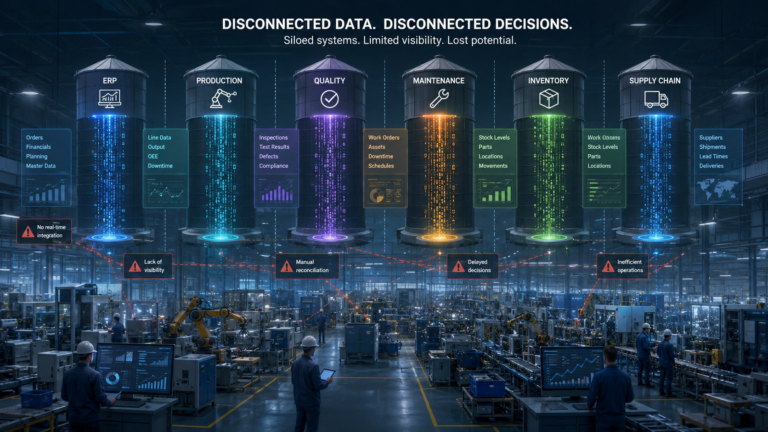
Every Monday, five people export the same data into five different spreadsheets, and by the time leadership sits down, you’ve got five versions of the truth, and none of them line up. Your problem isn’t that you don’t have data. It’s that you have too many disconnected copies of it, and no agreement on which one counts.
Walk into a mid-market operations review, and you can usually spot the report sprawl before anyone opens their laptop. Production has its throughput sheet. Quality has its scrap tracker. Supply chain has its inventory export. Finance has the margin view. Each is built by a good person doing careful work — and each pulls from a slightly different source, defines its terms a little differently, and lands on a slightly different answer. Nobody is wrong, exactly. That’s what makes it so hard to fix.
What actually breaks is the pace of decisions. When leadership spends the first half of a meeting reconciling which number to believe, the second half — the part where you decide what to do about the line that’s slipping or the order that’s at risk — gets rushed or punted. Worse, by the time the reports are assembled, they describe last week. You’re steering the plant through the rearview mirror. For a COO or VP of Operations, that lag is the whole game: a problem you catch Monday afternoon instead of the moment it happened is a problem that’s already cost you a shift.
The supply-chain version is sharper still. If your inventory and OTIF picture lives across three sites and four spreadsheets, you don’t have visibility — you have a reconstruction project. You can’t promise a date you can’t see, and you can’t rebalance stock you can’t count in real time. The cost isn’t just the analyst hours; it’s the expedite freight and the customer calls that come from finding out too late.
Here’s the Fuzzitech line, same as always: a dashboard on top of ungoverned data is just a prettier argument. Operational Intelligence only works when the layer beneath it is trustworthy. So we fix the foundation first. In the 2-Week Diagnostic, we inventory every report in circulation, trace each back to its source, and surface the places where the same KPI is defined three different ways. Then we build a single governed data model — one definition of throughput, one of on-time, one of available inventory — that every function agrees to.
On top of that foundation goes the Operational Intelligence layer: Power BI and ERP analytics wired to live, governed data, rather than overnight exports. One dashboard, one set of definitions, refreshed close to real time, that production, supply chain, quality, and finance all read from. This is the same architecture behind our Azure AI Copilot for Unified Commerce work — once the operational picture is unified and trustworthy, you can put a copilot on top and let people ask it questions in plain language instead of hunting through tabs. But the copilot is the last step, not the first.
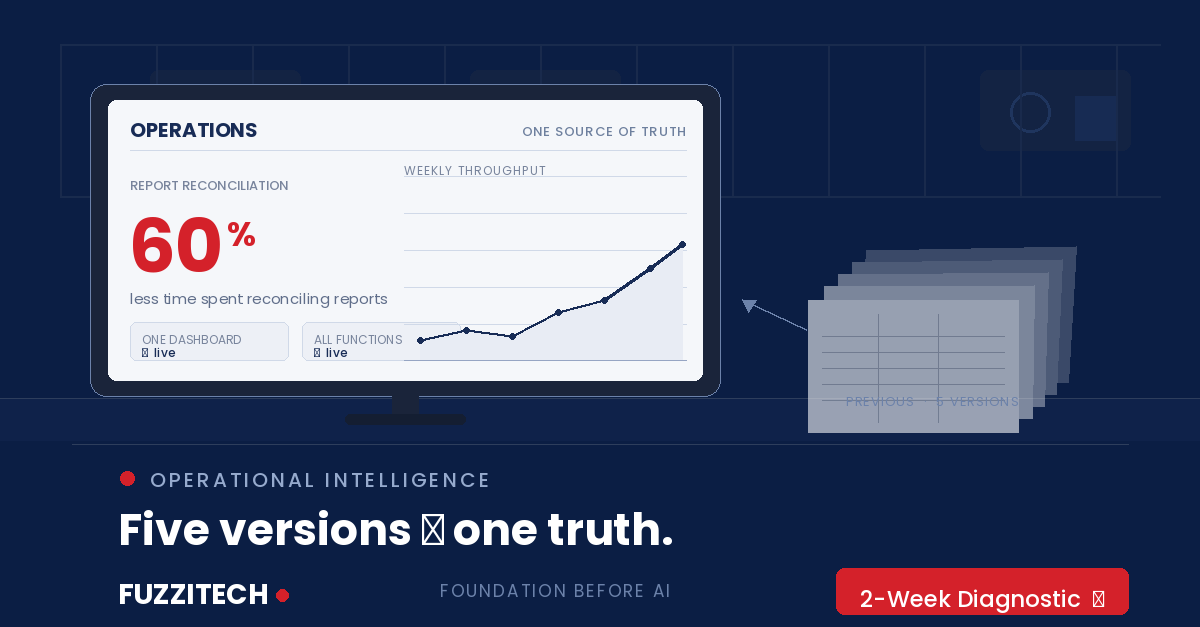
The measurable “after” is concrete. Teams that consolidate onto governed Operational Intelligence typically spend around 60% less time reconciling conflicting reports — the Monday export ritual simply ends. One trusted dashboard replaces the five-plus versions that once circulated, so your operations review starts with decisions rather than debates. And because the data is live rather than last week’s, you catch the slipping line while you can still do something about it. (Any specific hours-saved or throughput-lift numbers beyond those anchors are illustrative until we baseline your operation.)
There’s a cultural shift underneath the technical one, and it’s the part operators tell us they value most. When everyone reads from the same source, meetings get shorter and calmer. The conversation moves from “whose number is right” to “what are we going to do.” That’s not a software feature; it’s what a real foundation buys you.
And, as with everything we build, the same governed layer that powers today’s dashboard will be what tomorrow’s forecasting or predictive use case needs underneath it. You’re not just cleaning up reporting. You’re laying the track.
The five-spreadsheet Monday isn’t a data shortage — it’s a foundation gap, and a single governed dashboard closes it.
Book the 2-Week Diagnostic, and we’ll map every report in circulation, find the conflicting definitions, and hand you a prioritized roadmap to one source of truth in 14 days.
See more details: https://fuzzitech.com/industries/manufacturing/operational-intelligence/
See the manufacturing use cases → https://fuzzitech.com/use-cases/manufacturing-use-cases