The first sign that your critical asset was in trouble shouldn’t be a line down at 2 a.m. and a customer asking where their order is. On most floors, maintenance is still either “run it till it breaks” or “swap parts on a calendar whether they need it or not.” Both of those quietly cost you every month, and neither one saw the failure coming.
The “before” state is familiar to anyone who’s run a plant. Reactive maintenance means you’re fast and expensive after the fact — a breakdown triggers a scramble, overtime, expedited freight to cover the missed shipment, and a customer relationship that takes a small dent. Calendar-based maintenance feels more disciplined, but it just trades one waste for another: you’re pulling parts that still had life left in them, taking planned downtime you didn’t need, and still getting caught by failures that don’t land on a schedule. Neither approach tells you what a specific machine is actually about to do.
What breaks, in hard terms, is the shipment. A generator and plumbing manufacturer we worked with lived this: a critical asset would fail without warning, the line would stop, and the failure would cascade straight into missed delivery dates. The maintenance cost of the breakdown was real, but the downstream cost — the expedites, the overtime, the missed OTIF — was bigger and less visible. For a logistics or supply-chain operator, swap “line down” for “equipment or fleet asset down,” and the story is identical: an unplanned failure doesn’t stay contained to the maintenance budget. It shows up as a late delivery.
Now, the temptation is to jump straight to “let’s put AI on it.” And this is exactly where predictive maintenance projects fail. A prediction model is only as good as the data it learns from, and on most floors that data isn’t there yet — sensor readings that never get stored, maintenance history that lives in a technician’s notebook or a paperwork order, machine data that’s trapped in a historian and never connected to failure records. Point an algorithm at that, and it can’t find the pattern, because the pattern was never captured in the first place. This is foundation-before-AI in its purest form.
So the Fuzzitech approach to Predictive Analytics & Maintenance AI starts underneath the model. In the 2-Week Diagnostic, we assess what condition and maintenance data you’re actually capturing, where the gaps are, and what it would take to connect real-time machine signals to your maintenance history — which usually means shoring up the IT/OT integration layer first. We get the sensor data flowing and stored, we get the failure and work-order history into a usable structure, and we tie them together. Only then do the predictive models have something honest to learn from.
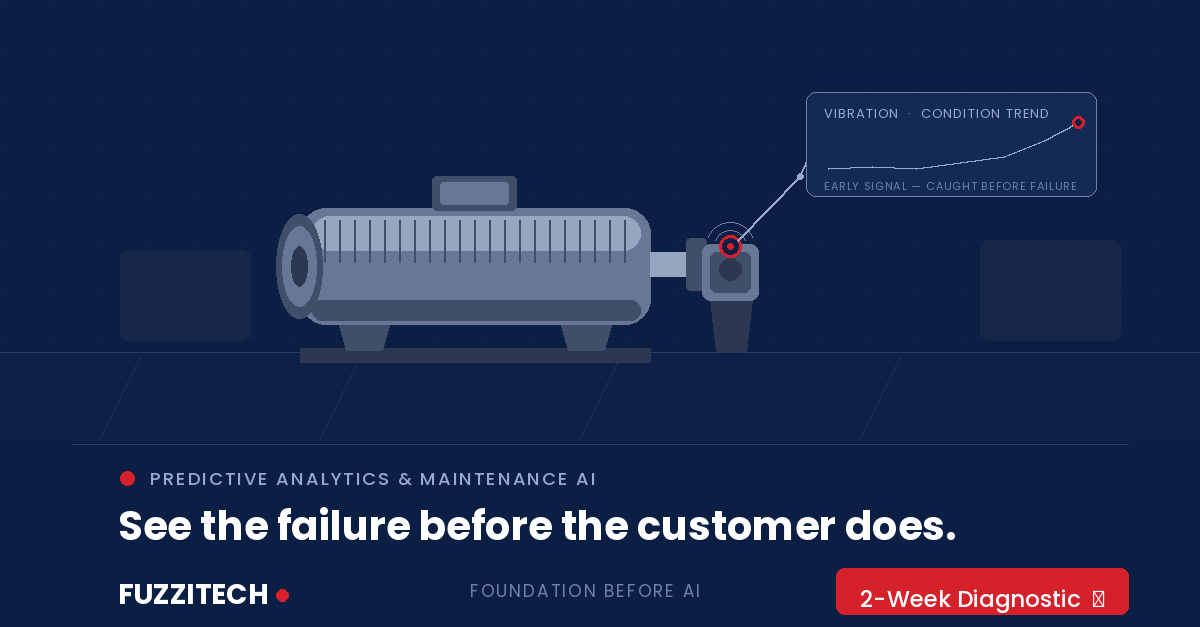
Once that foundation holds, the payoff is the one everyone actually wants: the models start flagging early signals — the vibration drift, the temperature creep, the current draw trending wrong — before the asset fails, so you can intervene during planned downtime rather than at 2 a.m. That’s the shift from finding out about a failure due to the shipping delay to scheduling around it a week in advance.
The measurable “after” is the anchor we stand behind: operators running predictive maintenance on a proper data foundation typically see around a 40% reduction in unplanned downtime. That’s fewer 2 a.m. scrambles, fewer expedites, and delivery dates you can actually hold. (Specific dollar savings, MTBF gains, or parts-cost reductions beyond that are illustrative until we baseline your assets — the diagnostic is how we get you a real number.)
And, predictably, the same foundation compounds. The connected machine data that powers predictive maintenance is the same data that feeds Operational Intelligence and, eventually, broader AI use cases. You don’t build a one-off for maintenance and throw it away; you build the layer once and keep drawing on it.
The honest framing we give every operator: predictive maintenance isn’t magic, and it isn’t a product you buy and switch on. It’s clean, connected data plus a model that’s had something real to learn from. Get the foundation right, and the downtime numbers follow. Skip it, and you’ve bought an expensive way to be wrong.
Takeaway: Predictive maintenance doesn’t start with the model — it starts with the sensor and maintenance data you’re not capturing yet.
CTA: Start with the 2-Week Diagnostic. We’ll map your condition data gaps, tell you exactly what predictive maintenance would entail for your assets, and hand you a prioritized roadmap in 14 days.
See more details
See the manufacturing use cases → https://fuzzitech.com/use-cases/manufacturing-use-cases