Companies that support the U.S. Department of Defense are entering a new phase of cybersecurity accountability.
For years, defense contractors and subcontractors have been expected to protect sensitive government-related information. But with the Cybersecurity Maturity Model Certification, commonly known as CMMC, those expectations are becoming more structured, more visible, and more directly connected to contract eligibility.
For manufacturers, engineering firms, technology providers, logistics companies, and service organizations in the Defense Industrial Base, CMMC is not just an IT requirement. It is becoming a business requirement.
If your company wants to win, retain, or support DoD-related work, you may need to prove that your organization can properly protect sensitive information such as Federal Contract Information, known as FCI, and Controlled Unclassified Information, known as CUI.
What Is CMMC?
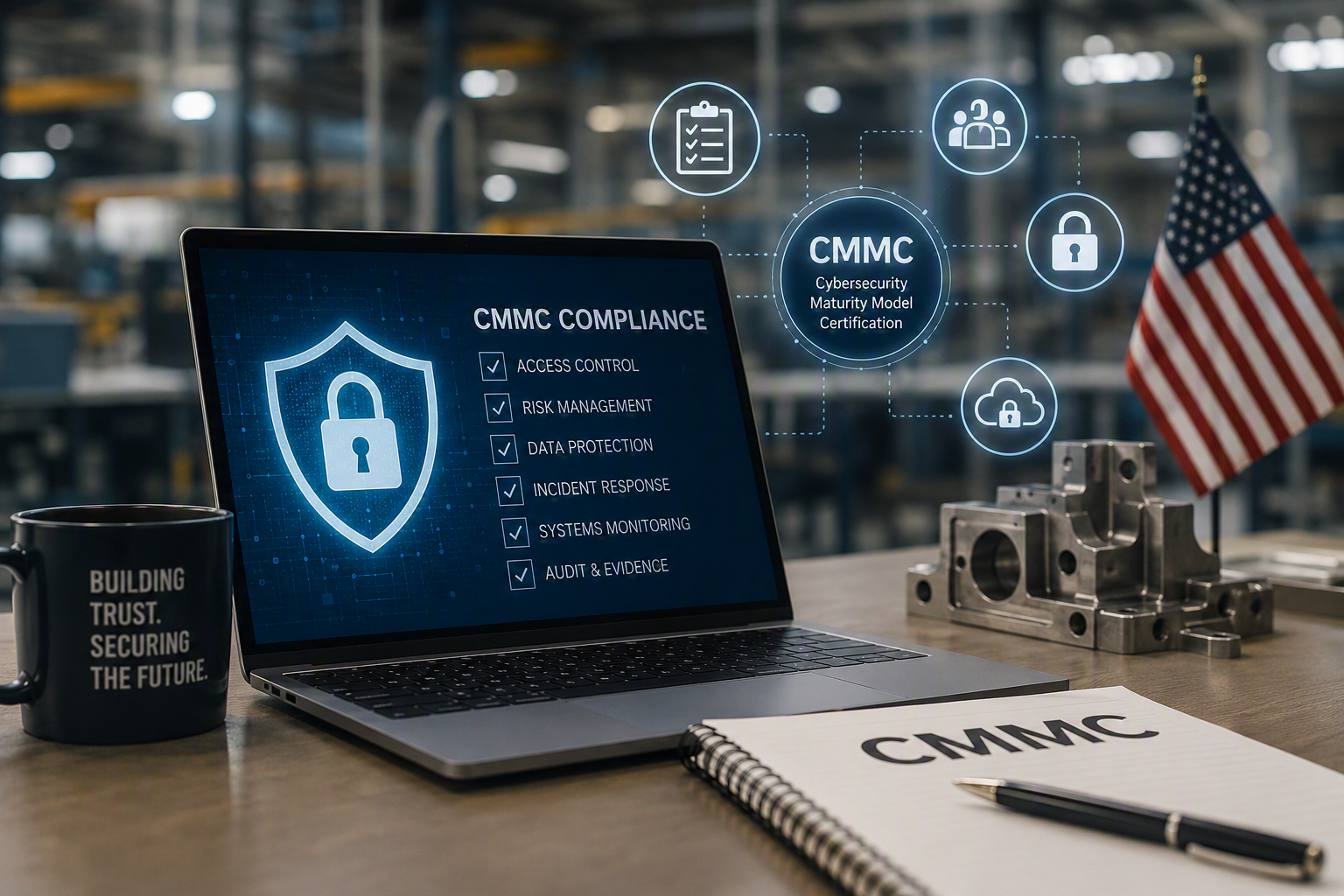
CMMC stands for Cybersecurity Maturity Model Certification.
It is a U.S. Department of Defense program designed to verify that defense contractors and subcontractors are implementing cybersecurity protections for FCI and CUI. The DoD describes CMMC as a framework for assessing contractor information security protections, and the DFARS now includes policies and procedures for adding CMMC-level requirements to DoD contracts. (Acquisition.gov)
The purpose is straightforward: strengthen cybersecurity across the Defense Industrial Base and reduce the risk that sensitive defense information is exposed, stolen, mishandled, or accessed by unauthorized users.
CMMC matters because it affects more than prime contractors. It can also apply to subcontractors, manufacturers, suppliers, engineering partners, IT providers, logistics partners, and other companies that process, store, or transmit FCI or CUI in support of DoD work.
Why CMMC Matters Now
CMMC requirements are now moving into implementation. The DoD’s CMMC resources state that phased implementation began on November 10, 2025, with Phase 1 focused primarily on CMMC Level 1 and Level 2 self-assessments. (Defense Department CIO)
This means companies should not wait until a customer, prime contractor, or government solicitation forces the issue.
CMMC readiness can take time, especially for companies with fragmented systems, unmanaged file shares, broad access permissions, limited documentation, weak evidence management, or unclear data flows. Waiting too long can create business risk.
For companies in the defense supply chain, CMMC readiness is not only about cybersecurity. It is about protecting future revenue, strengthening customer trust, and demonstrating that the organization is prepared to handle sensitive information responsibly.
The Three CMMC Levels
CMMC is organized into three levels. The required level depends on the type of information the company handles and the contract requirements.
Level 1: Foundational
CMMC Level 1 applies to companies that handle Federal Contract Information, but not Controlled Unclassified Information.
Level 1 focuses on basic FCI safeguarding. The DoD describes Level 1 as covering the basic safeguarding requirements from FAR 52.204-21. (Defense Department CIO)
At this level, companies typically need to implement basic cybersecurity practices such as limiting access to authorized users, protecting systems from malicious code, controlling physical access, and maintaining basic safeguarding controls.
Level 1 is generally addressed through self-assessment and affirmation, in accordance with the applicable CMMC requirements.
Level 2: Advanced
CMMC Level 2 applies to companies that handle Controlled Unclassified Information.
Level 2 is based on the security requirements in NIST SP 800-171, which includes 110 security requirements. DoD CMMC guidance describes Level 2 as aligned to NIST SP 800-171 requirements. (Defense Department CIO)
Level 2 may require either a self-assessment or a third-party assessment, depending on the contract and the sensitivity of the information involved.
For many defense manufacturers and suppliers, Level 2 is where the work becomes more significant. It requires stronger controls around access, identity, incident response, audit logging, configuration management, media protection, risk assessment, security awareness, system integrity, and protection of CUI environments.
Level 3: Expert
CMMC Level 3 applies to higher-risk environments and more sensitive CUI scenarios.
Level 3 builds on Level 2 and includes additional requirements designed to address advanced persistent threats. DoD CMMC documentation notes that NIST SP 800-172 provides the basis for CMMC Level 3 security requirements. (Defense Department CIO)
Level 3 generally requires a government assessment and is intended for companies supporting higher-risk DoD programs.
What Companies Need to Do to Be CMMC Compliant
CMMC compliance is not achieved by buying a single tool or writing a single policy. It requires a structured program that combines cybersecurity controls, data governance, process discipline, documentation, evidence, and ongoing monitoring.
Here are the practical steps companies need to take.
1. Determine What Information You Handle
The first step is to identify whether your company handles FCI, CUI, or both.
This matters because the type of information determines the likely CMMC level and the scope of the controls.
Companies should review:
- Contracts
- Purchase orders
- Technical drawings
- Engineering files
- Specifications
- Quality records
- Inspection documents
- Customer communications
- Supplier data
- Program documentation
- Shared files and portals
A manufacturer may not consider itself a defense contractor. Still, if it receives technical data, drawings, specifications, or controlled documents from a prime contractor or a DoD-related customer, CMMC may become relevant.
2. Define the CMMC Scope
Scoping is one of the most important parts of CMMC readiness.
Companies need to identify which systems, users, applications, cloud services, devices, networks, and vendors process, store, or transmit FCI or CUI.
This may include:
- Microsoft 365
- SharePoint
- Teams
- ERP systems
- CAD and engineering systems
- PLM systems
- Quality systems
- File shares
- Cloud storage
- Laptops and endpoints
- Supplier portals
- Backup systems
- Remote access tools
- Third-party managed service providers.
A scope that is too broad can make compliance more expensive and complex than necessary. A scope that is too narrow can miss systems that must be protected.
Good scoping helps companies focus their effort and reduce unnecessary complexity.
3. Map Data Flows
Before a company can protect sensitive information, it must understand how that information moves.
Data flow mapping helps answer:
- Where does FCI or CUI enter the organization?
- Where is it stored?
- Who accesses it?
- Which systems process it?
- Is it shared through email, file shares, portals, or collaboration tools?
- Is it sent to suppliers or subcontractors?
- Is it downloaded to local devices?
- Is it backed up securely?
- Is access logged and monitored?
This is especially important for manufacturers, where sensitive information may move between sales, engineering, production, quality, purchasing, suppliers, and customer service.
If the company does not understand its data flows, it cannot confidently define scope or implement the right controls.
4. Implement the Required Cybersecurity Controls
Once the scope is defined, companies need to implement the controls required for their CMMC level.
Depending on the level, this may include:
- Multi-factor authentication
- Identity and access management
- Role-based access control
- Endpoint protection
- Patch management
- Vulnerability management
- Secure configuration
- Network segmentation
- Audit logging
- Incident response procedures
- Backup and recovery
- Encryption
- Security awareness training
- Physical access controls
- Media protection
- Vendor access management
- Cloud security configuration
- Data loss prevention
- System monitoring
For many companies, this work will involve both technology implementation and process change.
For example, implementing MFA is technical. But reviewing user access, removing unnecessary permissions, training employees, documenting procedures, and collecting evidence are operational disciplines.
5. Document Policies and Procedures
CMMC requires companies to demonstrate not only that controls exist but also that documented policies and procedures support those controls.
Companies may need documentation for:
- Access control
- Incident response
- Risk management
- Configuration management
- Media protection
- Data handling
- Security training
- Backup and recovery
- User onboarding and offboarding
- Vendor access
- System monitoring
- Physical security
- Change management
Documentation must reflect how the company actually operates. A policy that exists only on paper and is not followed poses a risk during readiness review or assessment.
6. Create or Update the System Security Plan
For companies pursuing Level 2 or higher, a System Security Plan (SSP) is a critical document.
The SSP describes the system boundary, architecture, users, data, controls, and the company’s approach to meeting applicable security requirements. DFARS assessment language also references system security plan information associated with contractor information systems supporting DoD contracts. (Acquisition.gov)
The SSP is not simply a technical document. It is the company’s explanation of how it protects the environment.
A strong SSP should align with the actual scope, systems, controls, and evidence.
7. Track Remediation Through a POA&M
A Plan of Action and Milestones (POA&M) documents gaps that require remediation.
It should include:
- The control gap
- The risk
- The remediation action
- The owner
- The target date
- The current status
- Evidence required for closure
Not every gap can be deferred, and companies should understand which items must be fully implemented before assessment or contract award.
A well-managed POA&M gives leadership visibility into readiness and helps keep remediation work on track.
8. Prepare Evidence
CMMC is evidence-driven.
Companies must be able to show that controls are implemented and operating. Evidence may include screenshots, system configurations, access review logs, training records, policies, procedures, tickets, audit logs, incident response records, vulnerability scan results, and security tool reports.
Evidence should be organized, up to date, and mapped to the applicable requirements.
One of the biggest readiness challenges is not only implementing controls but also proving their implementation in an organized, repeatable way.
9. Complete the Required Assessment and Affirmation
The assessment path depends on the required CMMC level.
Level 1 generally involves self-assessment. Level 2 may require self-assessment or third-party certification, depending on the contract. Level 3 requires a government assessment.
DoD CMMC resources also remind contractors to submit affirmations with their CMMC assessments in SPRS. (Defense Department CIO)
Companies pursuing DoD contracts must pay close attention to what the solicitation or contract requires. DFARS procedures state that contracting officers check SPRS and shall not award a contract unless the offeror has current CMMC status at the required level for each applicable contractor information system. (Acquisition.gov)
10. Maintain Continuous Readiness
CMMC is not a one-time event.
Companies must maintain compliance as systems, users, contracts, data, and vendors change.
Continuous readiness includes:
- Regular access reviews
- Patch and vulnerability management
- Security monitoring
- Evidence updates
- Policy reviews
- User training
- Incident response testing
- Vendor access reviews
- Configuration management
- Executive reporting
- Ongoing remediation tracking
A company that treats CMMC as a one-time project may quickly fall out of readiness.
A company that treats CMMC as an operating discipline will be better prepared for future contracts, customer reviews, and security threats.
What This Means for Mid-Size Manufacturers
Mid-size manufacturers often face a practical challenge.
They may have strong operational discipline, but limited cybersecurity compliance resources. Sensitive files may be spread across email, SharePoint, Teams, ERP, CAD systems, quality systems, shared drives, laptops, and supplier portals. Access may have grown over time. Documentation may be incomplete. Evidence may be scattered.
For these companies, CMMC readiness should begin with a structured data and system audit.
Key questions include:
- Where do FCI and CUI live?
- Who has access?
- Which systems are in scope?
- How does sensitive information move through the business?
- Are permissions controlled?
- Are users trained?
- Are controls implemented?
- Can the company prove it?
- What gaps must be remediated first?
This is where a practical partner can help.
How Fuzzitech Helps
At Fuzzitech, we help organizations prepare for CMMC by combining data audit, systems integration, security implementation support, automation, documentation support, and compliance visibility.
Our work is designed to help companies move from uncertainty to execution.
Fuzzitech can support:
- CMMC readiness assessment
- FCI and CUI data discovery
- Data flow mapping
- System and application inventory
- Scope definition
- Gap analysis
- Remediation roadmap
- Microsoft 365 and Azure security implementation support
- Identity and access management improvements
- Role-based access design
- Endpoint and device management coordination
- Policy and procedure support
- SSP and POA&M support
- Evidence organization
- Compliance dashboards
- Workflow automation for evidence collection
- Executive reporting on readiness progress
- Ongoing data, compliance, and AI operations support
Our role is to help companies understand what they have, where risk exists, what needs to be fixed, and how to build a practical roadmap toward CMMC readiness.
Important Note on Certification
Fuzzitech helps organizations prepare for CMMC through data audit, readiness assessment, gap remediation, systems implementation support, documentation support, dashboards, automation, and evidence management.
Formal CMMC certification assessments must be performed through the appropriate authorized CMMC assessment ecosystem where required.
The distinction matters. Fuzzitech helps companies get ready, close gaps, implement controls, and organize evidence. The formal assessment must follow the required CMMC assessment process.
Final Thought
CMMC is more than a cybersecurity checklist. It is a test of whether a company can protect sensitive defense information in a disciplined, documented, and repeatable way.
For defense contractors and manufacturers, CMMC readiness can become a competitive advantage. It helps protect future contracts, strengthen customer trust, reduce cybersecurity risk, and create a more mature operating model.
The companies that start early will have more time to define scope, fix gaps, implement controls, organize evidence, and build continuous readiness.
The leadership question is simple:
Are we ready to prove that we can protect the information our defense customers trust us with?
If the answer is no, now is the time to begin.
Fuzzitech helps defense contractors, manufacturers, and suppliers prepare for CMMC by combining data audit, systems integration, security implementation support, automation, governance, and compliance visibility into a practical readiness roadmap.