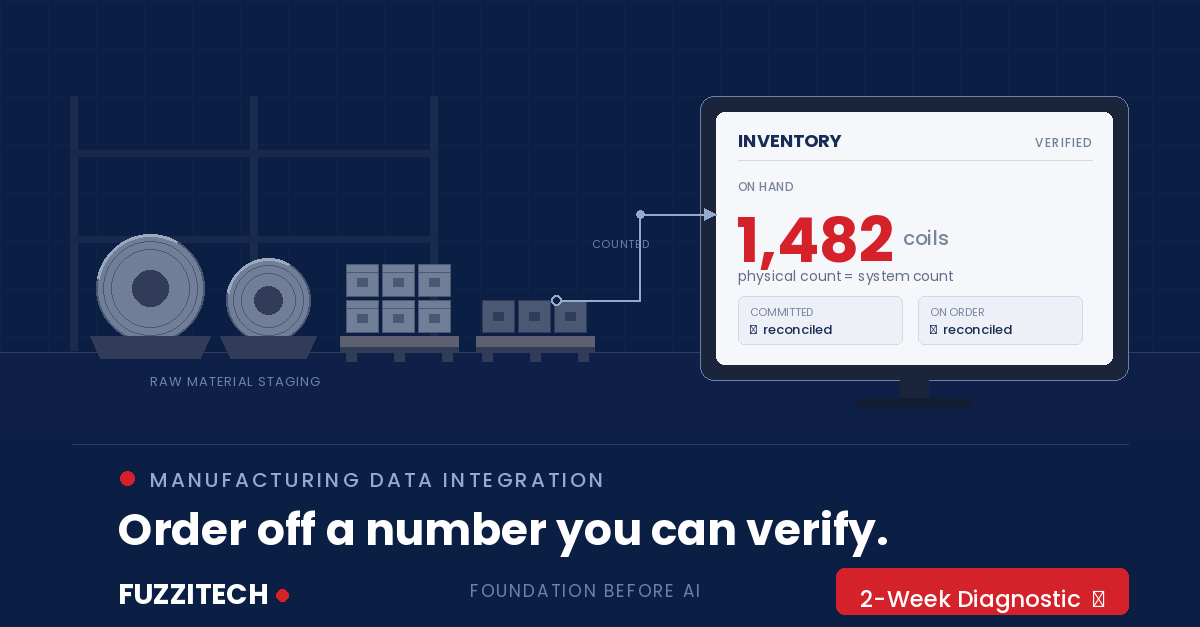
Your buyer is placing a raw-material order this afternoon. The number they’re working from came from the ERP, which was updated from a count someone did last Thursday and adjusted using a spreadsheet the planner keeps on their desktop. Nobody in the building can tell you, with confidence, how much of that material you actually have right now — so you either over-order and tie up cash, or under-order and expedite.
The “before” state in a mid-market plant is rarely a shortage of systems. It’s the opposite. You’ve got an ERP, probably a shop-floor system, maybe an MES, a quality database, a maintenance log, and — carrying more weight than anyone will admit in a meeting — a constellation of spreadsheets that individual people built because the systems didn’t talk. Each one holds a piece of the truth about what you have, what you made, and what you consumed.
The systems were bought at different times, by different people, for different reasons. That’s not a failure of judgment; that’s just what fifteen years of practical decisions look like. But the result is that your manufacturing data — inventory, production, consumption, scrap, work orders — lives in pieces that were never designed to reconcile with each other.
What actually breaks is procurement and planning. Raw-material ordering is the sharpest example, and it’s where the Midwest mid-market bleeds quietly. If your on-hand inventory number is a stale approximation, your buyer is guessing. Guess high, and you’ve got working capital sitting on the floor as steel, resin, or components you didn’t need this month. Guess low and you’re paying expedite freight, running overtime, or telling a customer the date moved. Neither shows up as a line item called “bad data.” It shows up as carrying costs and expedites, and everyone treats them as the cost of doing business.
For a logistics or supply-chain operator, the same fracture shows up in demand planning. You can’t forecast what you can’t see. If consumption data from the floor never cleanly ties back to inventory and order history, your demand signal is built on sand — and every downstream decision, from safety stock to supplier commitments, inherits that error.
Here’s the part operators find frustrating and true: this is precisely the moment when someone proposes buying an AI-driven ordering or forecasting tool. And a model pointed at fragmented, unreconciled manufacturing data will confidently produce an incorrect number. You will have automated the guess. That’s the whole reason we lead with foundation before AI — not as a slogan, but because we’ve seen what the alternative costs.
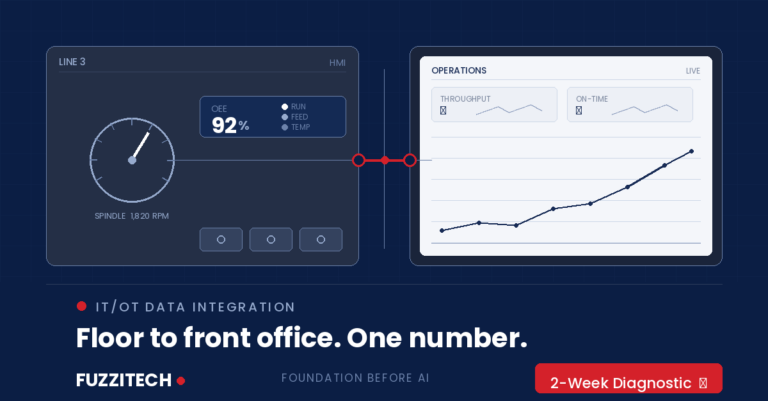
The Fuzzitech approach to Manufacturing Data Integration starts with the unglamorous work. In the 2-Week Diagnostic, we trace how a unit of material actually moves through your data: where it’s received, where consumption gets recorded (or doesn’t), which system holds the authoritative count, and every spreadsheet bridge in between. Almost every plant we walk finds at least one place where a critical number is maintained by one person, by hand, with no backup. Then we build the integration: connecting ERP, shop-floor, and inventory systems into a governed data layer with agreed definitions — one meaning for on-hand, one for consumed, one for committed — so the number your buyer sees is the number the floor is actually living.
Only on top of that foundation do we layer the intelligence. This is exactly the groundwork for an AI-Driven Raw Material Ordering Platform or an AI-Driven Demand Forecasting Platform: once material movement is captured cleanly and continuously, a model finally has something honest to learn from, and ordering can shift from reactive guesswork to a defensible recommendation.
The measurable “after” is the same trust dividend we see everywhere the foundation gets fixed. Teams typically spend around 60% less time reconciling conflicting reports — the planner’s private spreadsheet stops being load-bearing, because the systems agree. One trusted view replaces the five-plus versions that used to circulate before every purchasing decision. And the buyer places the order off a number they can actually verify. (Any specific inventory-reduction, carrying-cost, or expedite-savings figures are illustrative until we baseline your operation — that’s what the diagnostic produces.)
The compounding benefit is worth naming. The integrated material and production data that fixes ordering today is the same data that feeds forecasting, operational intelligence, and predictive use cases tomorrow. You are not buying a point solution. You’re building the layer that every future use case will stand on.
None of this requires replacing your ERP. It requires connecting what you already own, governing it, and retiring the spreadsheets that have been quietly holding your supply chain together.
If your buyer can’t verify the number they’re ordering against, you don’t have a purchasing problem — you have a data-foundation problem.
Start with the 2-Week Diagnostic. In 14 days, we’ll map how material data actually moves through your systems, find the spreadsheet bridges, and hand you a prioritized roadmap.
Learn more about how this can be applied to your manufacturing: Manufacturing Data Integration | ERP, MES & Shop Floor Data
See the manufacturing use cases → https://fuzzitech.com/use-cases/manufacturing-use-cases