Manufacturers have made meaningful progress over the last several years by investing in dashboards and reporting tools.
For many organizations, dashboards have helped replace spreadsheets, reduce manual reporting, and give leaders better visibility into production, quality, downtime, labor, inventory, and executive KPIs. This has been an important step forward.
But manufacturing is entering a new phase.
The next competitive advantage will not come only from seeing what happened. It will come from helping leaders and teams understand why it happened, what is likely to happen next, and what action to take.
That is why manufacturers need to move from traditional insight dashboards to AI-enabled insights on operations data.
Dashboards create visibility. AI-enabled insights create a decision advantage.
Dashboards Help You See the Business
A good dashboard gives manufacturing leaders visibility into important performance areas.
It can show:
- Production output
- Machine utilization
- Downtime
- Scrap and rework
- Labor productivity
- Inventory levels
- Order status
- On-time delivery
- Quality trends
- Executive KPIs
This visibility matters. Without dashboards, many teams are stuck with delayed reports, spreadsheet exports, inconsistent numbers, and management meetings where people debate the data rather than solve the problem.
Dashboards help create a common view of performance.
But dashboards also have limits.
A dashboard can show that downtime has increased. It may not explain the root cause.
A dashboard can show that scrap is trending higher. It may not identify the pattern behind the defects.
A dashboard can show that labor productivity declined. It may not be clear that the decline is due to job mix, training gaps, schedule changes, or machine issues.
A dashboard can show that inventory is low. It may not indicate which orders, suppliers, or production schedules are at risk.
Dashboards answer the question: What happened?
Manufacturers now need systems that also help answer: Why did it happen? What should we do next? What risk is forming? What decision should we make?
The Shift: From Visibility to Intelligence
The real opportunity lies in moving from passive reporting to active decision support.
AI-enabled insights enable manufacturers to use operational data more intelligently. Instead of relying solely on charts and reports, teams can identify patterns, surface exceptions, predict risk, and receive recommended next steps.
This does not mean replacing dashboards. Dashboards remain important.
The shift is about adding an intelligence layer to trusted manufacturing data.
That intelligence layer can help leaders ask and answer more valuable questions:
- Which production orders are at risk of missing delivery dates?
- Which machines are creating the most recurring downtime?
- Which defect categories are increasing and where?
- Which jobs are trending below the expected margin?
- Which materials are likely to create shortages?
- Which suppliers are contributing to production delays?
- Which shifts, work centers, or product families need attention?
- Which KPIs require executive action this week?
This is how manufacturing data becomes operational intelligence.
Why This Matters Now
Manufacturing leaders are under pressure to improve performance while managing complexity.
They face labor shortages, cost pressure, supply chain volatility, quality expectations, customer delivery demands, and pressure to adopt AI responsibly. At the same time, many companies are still managing operations through disconnected systems and manual analysis.
The organizations that win will not simply be the ones with the most data. They will be the ones who can turn data into better decisions faster than competitors.
AI-enabled insights help manufacturers:
- Identify problems earlier
- Reduce manual analysis
- Improve productivity
- Reduce downtime
- Improve quality
- Strengthen inventory planning
- Connect operations to financial impact
- Improve customer delivery performance
- Support faster management decisions
- Prepare the business for more advanced AI use cases
This is not about chasing AI trends. It is about improving the business’s operating rhythm.
Example: Improving Visibility Across Core Manufacturing KPIs
At Fuzzitech, we help manufacturing teams improve visibility into the areas that matter most to operational performance.
These areas include production, quality, downtime, labor, inventory, and executive KPIs.
This visibility becomes the foundation for AI-enabled insights.
Production Visibility
Production leaders need to know what is happening across lines, machines, work centers, shifts, jobs, and plants.
Traditional dashboards can show output, throughput, schedule adherence, work order progress, and production performance.
AI-enabled insights can go further by helping teams understand:
- Which orders are falling behind schedule
- Which work centers are creating bottlenecks
- Which product families consume more capacity than expected
- Which production patterns are affecting on-time delivery
- Which schedule changes are likely to create downstream issues
This helps leaders move from reviewing production performance after the fact to managing production risk as it develops.
Quality Visibility
Quality issues can be expensive. Scrap, rework, returns, inspections, and customer complaints all affect margin and trust.
Dashboards can show defect counts, scrap trends, inspection results, and rework levels.
AI-enabled insights can help identify:
- Which defect types are increasing
- Which machines, shifts, suppliers, or materials are connected to quality problems
- Which quality issues are most likely to affect customer delivery
- Which corrective actions are working
- Where root-cause investigation should begin
This allows quality teams to move faster from detection to prevention.
Downtime Visibility
Downtime is one of the clearest areas where better data can create business value.
Dashboards can show downtime frequency, duration, causes, and machine utilization.
AI-enabled insights can help teams understand:
- Which downtime events are recurring
- Which machines are likely to cause future production delays
- Which maintenance activities reduce downtime
- Which downtime causes have the highest financial impact
- Which production schedules are most exposed to equipment risk
This helps manufacturers move from reactive maintenance to more proactive performance management.
Labor Visibility
Labor productivity is a major concern for manufacturers, especially in an environment where hiring and retention are challenging.
Dashboards can show labor hours, overtime, productivity, attendance, and shift performance.
AI-enabled insights can help identify:
- Which jobs require more labor than expected
- Which shifts or work centers need support
- Where training gaps may be affecting output or quality
- How labor availability affects production schedules
- Where overtime is increasing without improving throughput
This gives leaders better insight into how labor performance connects to production, quality, delivery, and cost.
Inventory Visibility
Inventory has a direct impact on cash, production flow, and customer delivery.
Dashboards can show stock levels, inventory turns, shortages, excess inventory, and purchase order status.
AI-enabled insights can help teams identify:
- Which materials are likely to stock out
- Which shortages may delay production orders
- Which suppliers are creating material risk
- Which items are slow-moving or obsolete
- Where inventory decisions are tying up working capital
- Which purchase orders need attention now
This helps manufacturers reduce both excess inventory and material shortages.
Executive KPI Visibility
Executives need a clear view of how operations affect business outcomes.
Dashboards can show revenue, margin, delivery performance, capacity, quality, inventory, cost, and customer risk.
AI-enabled insights can help executives understand:
- Which operational issues are affecting the margin
- Which customers or products create the most complexity
- Which plants, lines, or departments need attention
- Which KPIs are trending in the wrong direction
- Which risks require leadership action this week
- Where AI and automation can create measurable value
This gives leadership a stronger connection between operational activity and business performance.
From Dashboards to AI-Enabled Decision Support
The journey from dashboards to AI-enabled insights usually happens in stages.
- Connect the Data
Manufacturers need to integrate data from ERP, shop-floor systems, quality systems, maintenance systems, inventory systems, labor systems, and finance systems.
This creates the foundation for trusted insights.
- Define the KPIs
The organization must agree on how key metrics are calculated.
For example:
- Downtime
- Utilization
- Scrap
- Rework
- Labor efficiency
- On-time delivery
- Inventory turns
- Job margin
- Production attainment
- Schedule adherence
Without common definitions, AI-enabled insights will not be trusted.
- Build Role-Based Dashboards
Dashboards should be designed for the decisions each role needs to make.
Executives, plant managers, production supervisors, quality leaders, maintenance teams, inventory planners, and finance leaders all need different views.
- Add Alerts and Exceptions
The next step is to move beyond static reporting.
Manufacturers can create alerts for:
- Orders at risk
- Inventory shortages
- Late purchase orders
- Downtime spikes
- Scrap increases
- Labor productivity drops
- Margin variances
- Quality exceptions
This helps teams act faster.
- Apply AI to Identify Patterns and Recommend Actions
Once the data foundation is trusted, AI can help identify patterns, summarize risks, detect anomalies, and recommend next steps.
This is where dashboards evolve into decision support.
- Create AI-Assisted Operating Rhythm
The final step is embedding AI-enabled insights into daily operations.
For example:
- A daily plant summary for supervisors
- A weekly executive KPI summary
- A downtime risk report for maintenance
- A quality pattern summary for quality teams
- An inventory risk summary for the supply chain
- A margin variance summary for finance
This makes AI part of how the business operates, not just a separate experiment.
AI-Enabled Insights Are Not a Replacement for People
AI should not replace manufacturing judgment. It should support it.
The people closest to the work still understand the context of the plant, the customer, the equipment, and the process. AI can help them see patterns faster, ask better questions, and focus attention where it matters most.
The best AI strategies for manufacturing are human-centered. They help supervisors, managers, analysts, and executives make better decisions with better information.
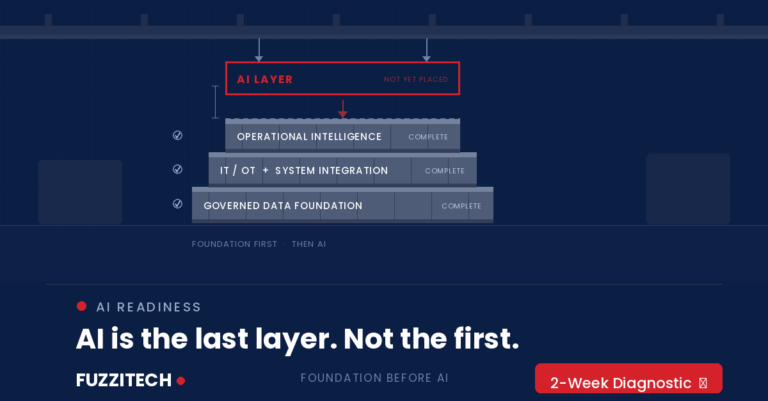
Why a Trusted Data Foundation Comes First
AI-enabled insights depend on trusted operations data.
If the data is incomplete, inconsistent, or disconnected, AI will produce unreliable answers. That creates risk and reduces confidence.
Manufacturers should not simply layer AI on top of messy data. They need a foundation that includes:
- Data integration
- Data quality checks
- Common KPI definitions
- Security and role-based access
- Governance
- Business context
- Human review for critical decisions
This foundation allows AI to be practical, trusted, and scalable.
The Competitive Edge
Manufacturers that move from insight dashboards to AI-enabled insights can gain a meaningful competitive edge.
They can operate at a higher speed, with greater clarity and confidence.
They can identify issues before they become expensive.
They can reduce manual reporting and analysis.
They can improve quality and delivery performance.
They can optimize labor and inventory decisions.
They can connect operations to financial outcomes.
They can make AI useful for everyday business decisions.
This is the next step in manufacturing digital transformation.
The future is not only about collecting more data. It is about using data to guide action.
Fuzzitech’s Approach
At Fuzzitech, we help manufacturers move from disconnected data and static dashboards to AI-enabled operational intelligence.
Our work starts with understanding the business outcomes that matter most. We assess the current systems, data sources, reporting gaps, KPI definitions, and AI readiness. Then we help create a practical roadmap to improve visibility and move toward AI-enabled insights.
We help teams improve visibility into:
- Production
- Quality
- Downtime
- Labor
- Inventory
- Executive KPIs
From there, we help build the connected data foundation, dashboards, alerts, automation workflows, and AI-enabled insights needed to improve performance.
Our focus is practical and outcome-driven: better decisions, faster action, fewer surprises, and a stronger foundation for AI.
The Leadership Question
Manufacturers should ask one important question:
Are our dashboards only showing us what happened, or are they helping us improve what happens next?
The next stage of manufacturing performance will come from AI-enabled insights built on trusted operations data.
The companies that build this capability now will be better positioned to improve productivity, reduce downtime, strengthen quality, optimize inventory, and gain a competitive edge.
Fuzzitech helps manufacturers turn operations data into trusted dashboards, actionable insights, and AI-enabled decision support that improves performance across the business.