Manufacturing leaders are operating in one of the most complex business environments in decades. They are being asked to improve productivity, reduce costs, increase quality, manage labor constraints, respond to supply chain volatility, and prepare for AI-driven transformation — often while relying on disconnected systems and manual reporting.
Most manufacturers already have valuable technology in place. They may use ERP systems, shop-floor systems, quality platforms, maintenance logs, spreadsheets, production schedules, finance reports, and customer order data. But in many organizations, these systems do not work together as one connected operating model.
That is why manufacturing leaders need an Operational Intelligence Strategy.
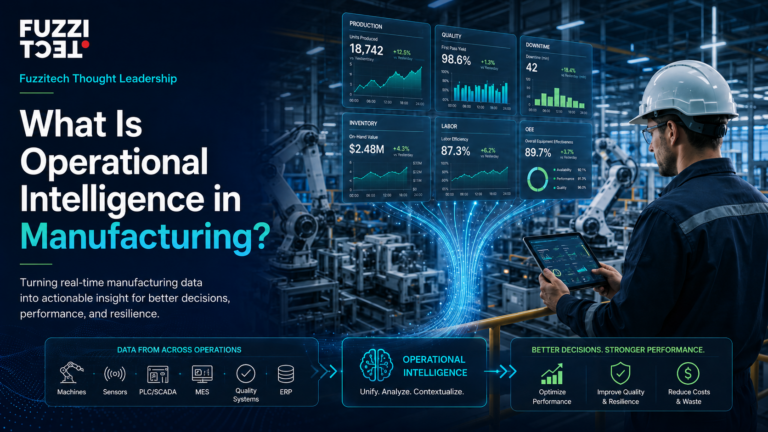
Operational intelligence is the ability to connect data across the business, understand what is happening in operations, identify performance issues earlier, and guide better decisions across the plant, finance, quality, supply chain, and executive leadership.
It is not just about dashboards. It is about turning manufacturing data into business action.
The Problem: Manufacturing Data Is Often Trapped in Silos
Many mid-market manufacturers are not short on data. They are short on connected, trusted, and actionable data.
Production data may live in one system. Quality data may live in another. Maintenance records may be captured in spreadsheets or work order notes. ERP data may show orders, inventory, costs, and financials, but may not easily connect to what is happening on the shop floor. Finance may spend hours reconciling operational reports with accounting results.
When these systems are disconnected, leaders face several challenges:
- Plant managers do not have a real-time view of production performance.
- Executives cannot easily see how operational issues affect margin and customer delivery.
- Quality teams struggle to connect defects to machines, shifts, suppliers, or work orders.
- Maintenance teams respond to equipment failures rather than predict them.
- Finance teams spend too much time reconciling data instead of analyzing performance.
- AI initiatives produce inconsistent results because the underlying data is not ready.
The result is a manufacturing business that may have many systems, but still lacks operational visibility.
Dashboards Alone Are Not Enough
Dashboards are useful, but they are only the starting point.
A dashboard can show that downtime increased last week. Operational intelligence helps explain why downtime increased, which machines or jobs were affected, what the financial impact was, and what action should be taken.
A dashboard can show that scrap increased. Operational intelligence helps identify whether the issue is tied to a supplier, material batch, machine, operator, shift, process step, or inspection pattern.
A dashboard can show that orders are late. Operational intelligence helps determine whether the root cause is capacity, scheduling, inventory, quality rework, labor availability, or supplier delays.
Manufacturing leaders need more than reporting. They need a connected intelligence layer that helps the organization move from reactive management to proactive decision-making.
What an Operational Intelligence Strategy Means for Manufacturers
An operational intelligence strategy gives manufacturers a practical roadmap for connecting systems, improving visibility, and preparing for AI. It should focus on business outcomes first, not technology first.
For manufacturers, this strategy should include five important elements.
1. Clear Business Outcomes
The first step is to define the operational and financial outcomes that matter most.
Examples may include:
- Improve machine utilization
- Reduce unplanned downtime
- Increase on-time delivery
- Reduce scrap and rework
- Improve labor productivity
- Improve production scheduling
- Increase inventory accuracy
- Reduce manual reconciliation
- Improve margin visibility
- Build AI readiness across operations
When the business outcome is clear, the data strategy becomes more focused. Instead of trying to connect everything at once, the company can prioritize the systems, data sources, and workflows that directly support measurable value.
2. A Connected Manufacturing Data Foundation
Manufacturing data often spans multiple systems, including:
- ERP
- MES or shop-floor systems
- Machine monitoring systems
- Quality management systems
- Maintenance systems
- Inventory and warehouse systems
- Supplier data
- Finance and accounting systems
- Spreadsheets and manual operational logs
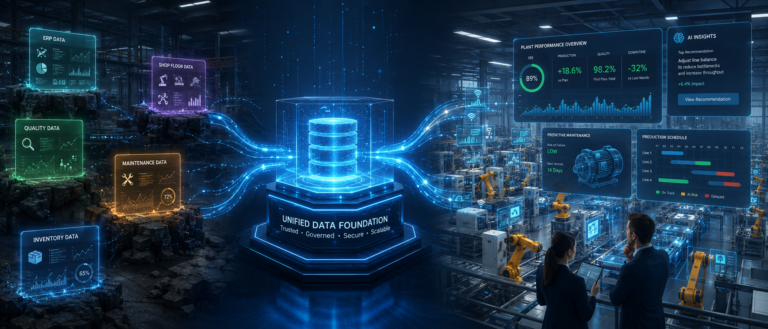
A connected data foundation brings these sources together into a trusted environment where data can be cleaned, standardized, governed, and used for reporting, analytics, automation, and AI.
This does not always require replacing existing systems. In many cases, manufacturers can unlock significant value by integrating the systems they already own.
3. Trusted KPI Definitions
One of the most common problems in manufacturing analytics is inconsistent definitions.
What counts as downtime?
How is utilization calculated?
What is included in labor efficiency?
How is scrap measured?
How is on-time delivery defined?
Which costs are included in the job margin?
If different teams define metrics differently, leadership cannot trust the numbers. An operational intelligence strategy creates common KPI definitions across operations, finance, quality, supply chain, and leadership.
This is where data governance becomes practical. Governance is not just a technical exercise. It is how the business builds confidence in decision-making.
4. Role-Based Visibility
Different leaders need different views of the business.
A CEO may need visibility into revenue, margin, capacity, delivery performance, and customer risk.
A COO may need throughput, downtime, bottlenecks, labor productivity, and plant performance.
A CFO may need visibility into costs, margins, inventory, and reconciliation.
A plant manager may need daily production, quality, labor, and maintenance insights.
A quality leader may need defect trends, root cause patterns, and supplier-related issues.
A maintenance leader may need asset history, failure patterns, and preventive maintenance opportunities.
Operational intelligence provides the right insight to the right person at the right time. This is how data becomes part of daily management, not just monthly reporting.
5. A Practical AI Roadmap
AI can deliver major value in manufacturing, but only when it is built on reliable data.
High-value manufacturing AI use cases may include:
- Predictive maintenance
- Quality defect detection
- Production forecasting
- Scheduling optimization
- Root cause analysis
- Inventory optimization
- Supplier risk analysis
- AI-assisted work instructions
- Operations copilots
- Automated reporting and exception alerts
However, AI should not begin with a tool purchase. It should begin with a readiness assessment. Manufacturers need to understand which use cases are feasible today, which data gaps must be addressed, and which projects can deliver the strongest return.
Operational intelligence creates the foundation for AI to move beyond experiments and become part of how the manufacturing business operates.
Why This Matters Now
Manufacturers are under pressure to do more with less. They need to improve productivity without adding unnecessary complexity. They need to use technology in ways that support frontline teams, improve management decisions, and strengthen financial performance.
An operational intelligence strategy helps manufacturing leaders answer critical questions:
- Where are we losing productivity?
- Which machines or processes create the most downtime?
- Where are quality issues starting?
- Which jobs are profitable and which are not?
- Which orders are at risk?
- Where are we carrying too much inventory?
- Which processes should be automated first?
- Are we ready to apply AI to our operations?
These questions cannot be answered consistently if the company’s data is fragmented.
Fuzzitech’s Approach
At Fuzzitech, we help manufacturing organizations move from disconnected systems and manual reporting to connected, intelligent operations.
Our approach typically begins with a Data & AI Diagnostic. We identify the highest-value use cases, map the current systems and data sources, define data gaps, assess reporting and AI readiness, and create a practical roadmap for implementation.
From there, we help manufacturers build the data foundation, dashboards, governance model, automation workflows, and AI capabilities needed to improve performance.
The goal is simple: help manufacturing leaders make better decisions, reduce operational friction, and prepare their organizations for AI with confidence.
The Leadership Question
For manufacturing leaders, the question is no longer whether the company has data. It does.
The real question is whether the company can turn that data into an operational advantage.
Can leaders trust the numbers?
Can teams see problems before they become expensive?
Can operations and finance work from the same version of the truth?
Can AI tools access clean, connected, and governed data?
Can the business move from reactive reporting to proactive decision-making?
If the answer is no, the organization does not just need another dashboard. It needs an operational intelligence strategy.
Fuzzitech helps manufacturers build the data foundation, analytics capability, and AI roadmap needed to move from fragmented operations to intelligent manufacturing.